Depth Over Hype: Why Liquidity Defines Sustainable Crypto Markets
Updated On 5 September 2025
Published On 15 December 2024

In crypto trading, attention often gravitates toward token launches, sudden price spikes, and social media trends. Yet for institutional market participants, real success is defined not by fleeting excitement but by market quality. What does that mean? Liquidity depth, execution reliability, slippage, and trust consistently outweigh the temporary pull of hype.
At DWF Labs, we work across crypto markets where these fundamentals determine whether traders remain engaged. This article explains why liquidity is the foundation of a healthy trading environment and why projects, crypto exchanges, and traders prioritize depth over noise.
Why Hype Alone Can’t Sustain Market Value
Crypto history is full of tokens that surged briefly on marketing and fear of missing out (FOMO) before collapsing. However, the foundations of these hype-driven markets are often shaky. A thin market, with few buy and sell orders at key price levels, cannot sustain elevated valuations. Even a modest sell order can trigger steep declines, and traders attempting to exit positions encounter heavy slippage or find no immediate counterparties.
Crypto traders that rushed in on the hype frequently experience significant slippage or are unable to exit positions without sinking the price. Real-world examples help illustrate this dynamic. In 2024, an analysis of token airdrops found that 88% of airdropped assets declined significantly within a few months. Often, the drop wasn’t simply due to fading interest, it was the result of low liquidity unable to support the valuation once early holders started selling.
A more well-known case is the collapse of FTX’s native token, $FTT. At its peak, $FTT had a market capitalization close to $10 billion. Yet it lacked the liquidity depth needed to absorb meaningful selling pressure. When market confidence declined, the absence of strong order book support accelerated its fall. With limited bids across the book, the price collapsed rapidly, leaving participants with little room to exit without realizing losses.
The example highlights a core lesson: hype may bring temporary volume, but without liquidity, it cannot support sustainable price discovery or protect traders from volatility. Depth is what enables markets to function smoothly once attention fades—and it’s why experienced participants assess liquidity metrics just as closely as they monitor price action.
Liquidity Depth and Its Role in Market Health
Liquidity depth refers to the concentration of buy and sell orders across the order book. A deep market absorbs significant trades without causing sharp price swings, which is essential for both retail and institutional traders.
For example, a $100,000 market order on BTC/USDT on a leading exchange will often execute with negligible slippage because of robust depth. In contrast, the same order on a newly listed altcoin can move the price several percent. This differentiation isn’t just theory. Empirical data from Coin Metrics and others shows that Bitcoin and Ethereum markets on Tier-1 exchanges maintain an average 2% market depth above $5 million. Meanwhile, over 80% of tokens listed on lesser-known venues exhibit less than $20,000 in visible depth within the same range, making these tokens fragile and difficult for serious participants to scale.
For crypto traders and exchanges alike, this disparity has real implications. Depth supports smoother execution, tighter spreads, and greater trust in the integrity of price action. Without it, markets remain vulnerable to volatility and sudden disruption.
Execution Quality and Slippage
Crypto liquidity does more than support efficient execution, it fosters trust. Traders, whether individual or institutional, want the cryptocurrency market to behave in a fair and predictable manner. A deep order book on a crypto exchange reduces the likelihood of extreme price moves from isolated trades, preventing manipulation and panic-driven volatility.
This matters not only for execution but also for perception. A trading platform with active participants and visible order depth across price levels signals stability. By contrast, an illiquid market is considered unreliable. Traders quickly learn to avoid environments where they can't transact at fair prices, especially during volatile periods.
Liquidity also plays a role in reputation. People tend to perceive crypto exchanges with deep books (which is often achieved and maintained by crypto market makers) as more trustworthy and professional. Their infrastructure can handle larger flows without disruption, which encourages both market participants and token teams to list and trade there.
For cryptoprojects, deep liquidity is just as important. It signals that the given cryptocurrency can support organic price discovery and manage trading volume without sudden changes. Teams that invest in crypto liquidity provisioning, whether via internal support or through partnering with professionals such as crypto market makers, are more likely to retain holders and attract new participants. Without this support, even the most promising tokens risk short-term volatility that damages long-term credibility.
Why Professional Crypto Traders Prioritise Depth, Not Hype
The difference between deep and shallow markets becomes especially clear when institutional or professional crypto traders evaluate where to allocate capital. Marketing or social media attention might bring temporary volume, but experienced participants focus on core trading conditions, raising questions:
- Is there sufficient depth to support large trades?
- Can sizable orders be executed without major price impact?
- Are spreads tight enough to enable efficient execution?
- Has liquidity remained stable across different market conditions?
If the answers aren’t satisfactory, capital moves elsewhere.
This is why many heavily promoted tokens fail to retain trading interest beyond the launch phase. Without consistent liquidity, traders experience slippage, failed orders, or sudden price drops and quickly exit. On the flip side, markets with real depth, even without much fanfare, tend to earn repeat participation because traders can enter and exit positions efficiently and without disruption.
The practical differences between deep and shallow markets are outlined in the comparison below:
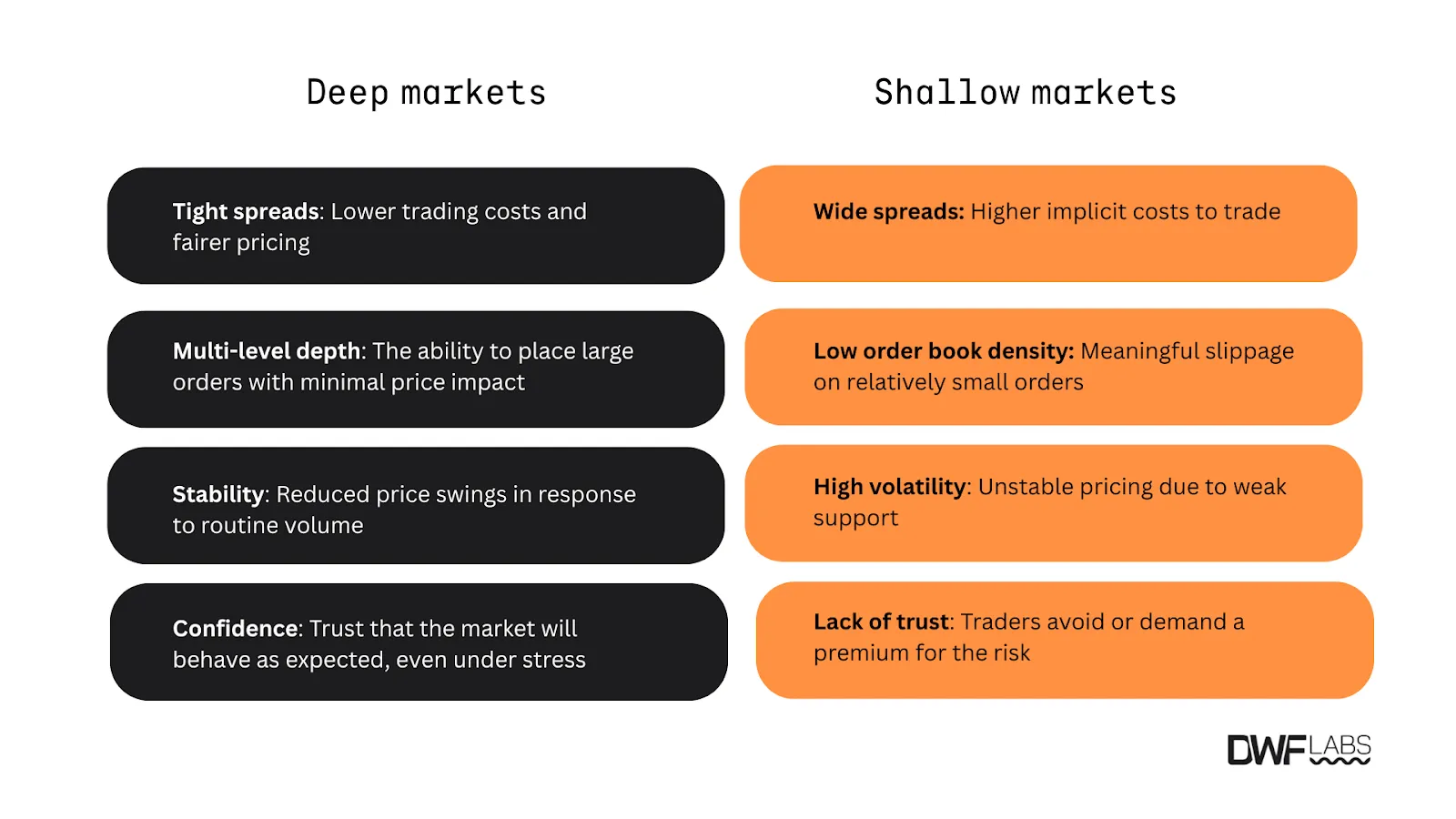
Over time, shallow markets either evolve, by investing in infrastructure and professional liquidity support, or fade as users migrate to more robust venues. For both token teams and exchanges, early and sustained focus on liquidity isn't just a technical concern; it's a core factor in long-term market credibility and retention.
Conclusion
In crypto markets, true resilience doesn’t come from short-term attention; it comes from sustained liquidity depth. Deep order books provide the foundation for confident trading by enabling smooth execution, reducing slippage, and preserving market integrity even in volatile conditions. For token teams, exchanges, and traders alike, market quality is increasingly measured by execution reliability and liquidity support—not price pumps or momentary volume spikes.
That’s where professional liquidity providers play a crucial role. By actively quoting across price levels, crypto market makers ensure consistent buy and sell interest, stabilize spreads, and help facilitate organic price discovery.
At DWF Labs, liquidity provisioning is core to our mission. By supporting over 60 crypto exchanges and over 750 token teams with structured market-making strategies, we help create markets where traders can transact confidently. We firmly believe that this principle forms the foundation of sustainable markets. As in traditional finance, depth consistently outperforms hype in crypto.
-960x540.webp?prefix=media)
-960x540.webp?prefix=media)