The Evolution of Perpetual Futures
Published On 18 September 2026

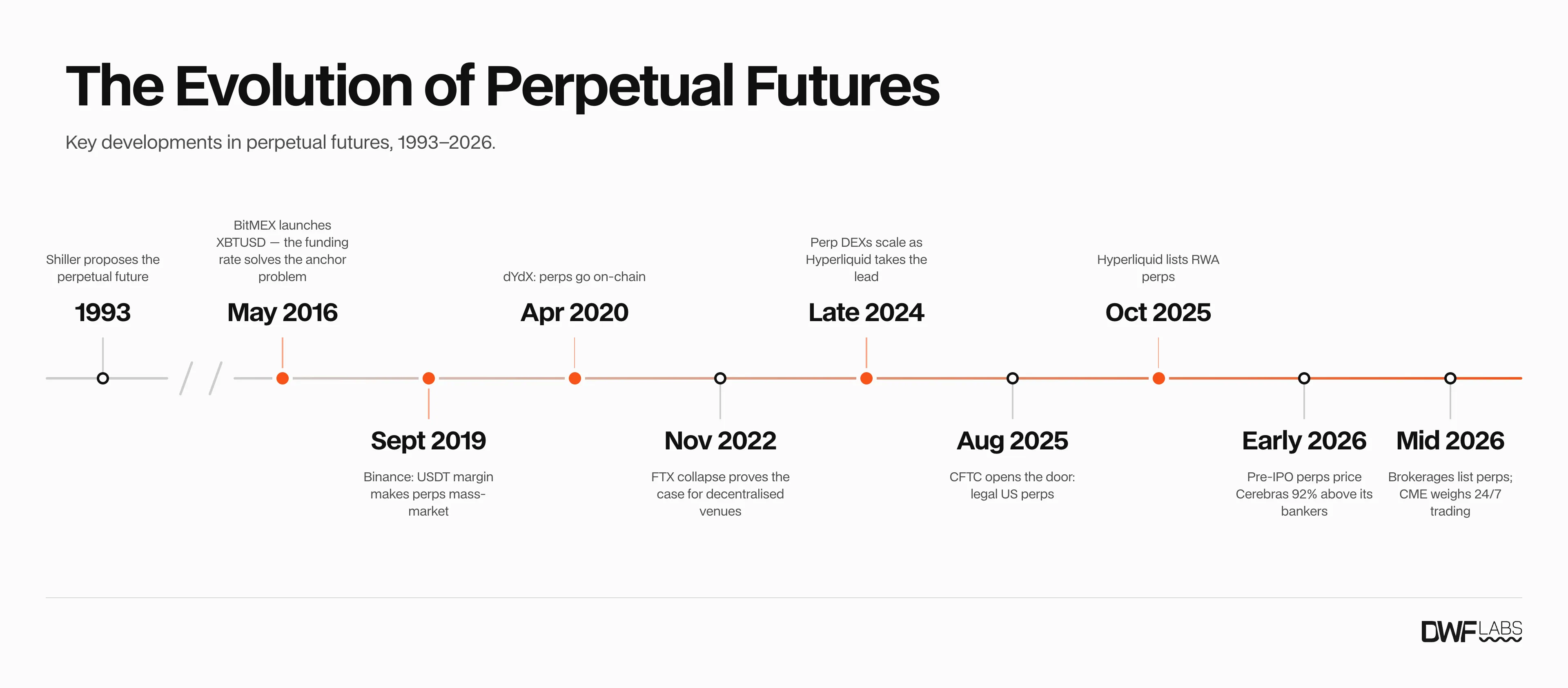
On May 13, 2016, BitMEX launched XBTUSD, a Bitcoin derivative that offered up to 100 times leverage and never expired.
10 years later, perpetual futures have become the dominant instrument in crypto trading. They moved from centralized exchanges onto blockchains, produced an entirely new class of trading venues, and began spreading across commodities, currencies, equity indices, and private companies. The most established derivatives exchanges in the world have since adopted parts of the model that crypto pioneered.
The history of perpetual futures is the story of an academic idea becoming a crypto-native product, then growing into a potential price-discovery layer for markets that barely existed when the idea was conceived.
The Birth of the Idea
Robert Shiller proposed the idea behind perpetual futures in 1993. His ambition extended well beyond financial speculation. He wanted to create markets for enormous assets that were difficult or impossible to trade directly: individual houses, labor income, and measures such as the consumer price index.

His proposed system combined two ideas. The first was an index capable of reconstructing a continuous price from infrequent sales of non-identical assets, such as two different houses. The second was a futures contract that would settle against that index every day but never expire. It was simple on paper and difficult to make work. Three problems stood in the way.
The anchor problem. A conventional futures contract eventually expires, forcing its price to converge with the underlying asset. A perpetual contract has no expiry, so another mechanism has to keep it close to spot.
The risk management problem. In traditional finance, if a leveraged position goes sour, the broker issues a manual "margin call," giving the trader hours or days to add collateral. Doing this in a perpetual contract with high leverage is impossible; a market crash would outrun the clearinghouse, causing systemic defaults.
The truth problem. A perpetual contract does not settle through delivery of the underlying asset. It relies on an index or oracle to determine what that asset is worth. The integrity of the contract therefore depends on the integrity of the price feed.
For more than two decades, Shiller's proposal remained largely theoretical. Then crypto supplied the market it needed: an asset trading continuously across multiple venues, a global population of speculative traders, and no legacy market structure hampering innovation.
BitMEX makes the perpetual work
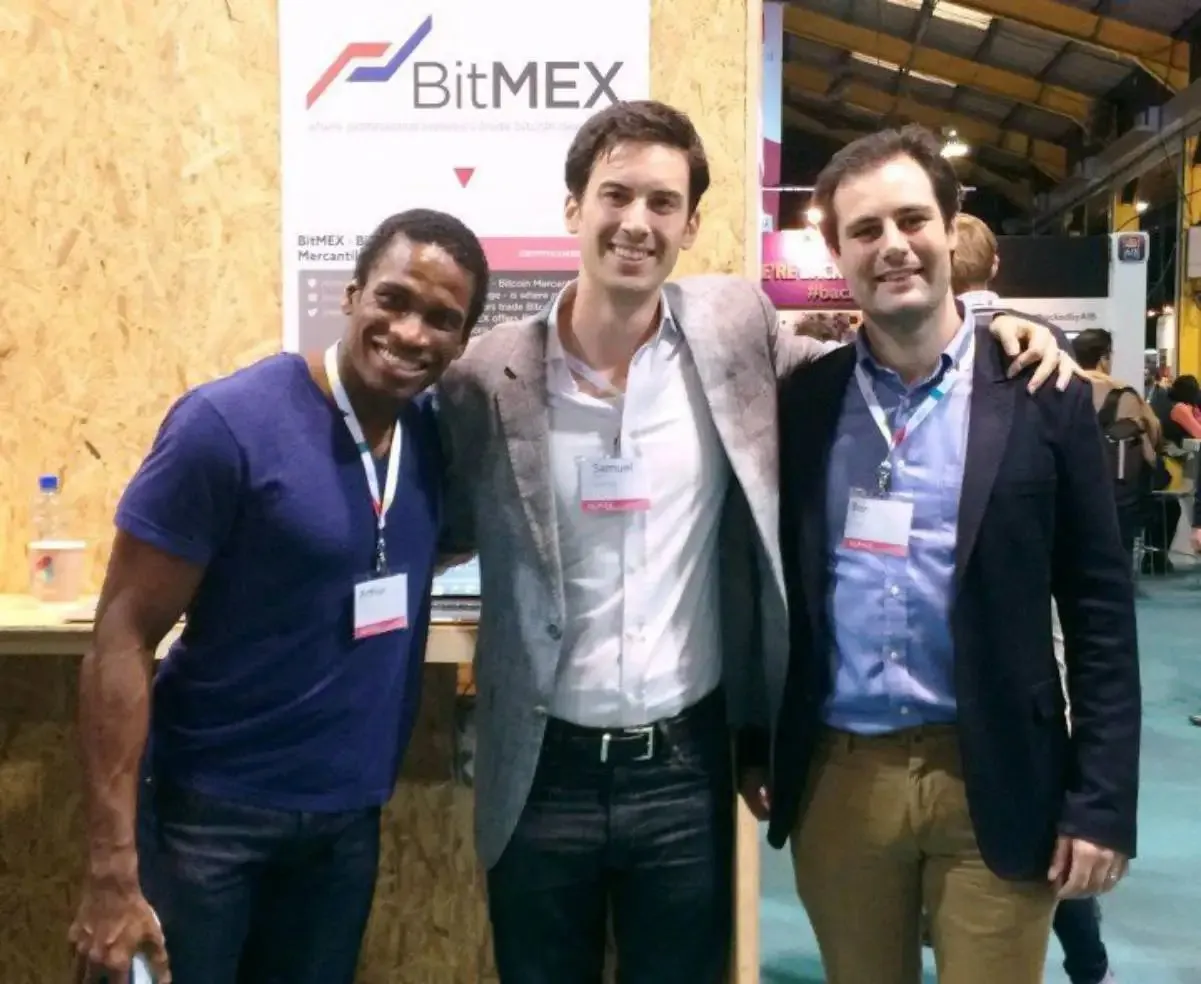
Arthur Hayes had been an equity derivatives trader and exchange-traded fund (ETF) market maker at Deutsche Bank and Citi in Hong Kong before he was laid off and started arbitraging Bitcoin prices between exchanges. He co-founded BitMEX with Ben Delo, a quant who'd worked at J.P. Morgan, and Samuel Reed, an engineer. The platform launched in November 2014. On May 13, 2016, it listed XBTUSD, the first perpetual futures with up to 100x leverage.
Their core breakthrough was the funding rate. At regular intervals, traders on one side of the market pay traders on the other. When the perpetual trades above the spot price, funding becomes positive and longs pay shorts. When it trades below spot, the payment reverses. The incentive naturally attracts traders to long/short whenever prices deviate too far, pulling the contract back toward the underlying market without requiring an expiry date.
BitMEX shipped two more inventions in the same launch that became industry standard. An insurance fund accumulated the surplus produced when liquidations closed at prices better than the theoretical bankruptcy price. Behind it sat auto-deleveraging, or ADL. If the insurance fund could not cover a loss, the exchange could forcibly close profitable positions on the winning side of the market.
But the product was still awkward for end users. XBTUSD was coin-margined: traders posted Bitcoin as collateral and received their profits in Bitcoin. Their collateral changed in value at the same time as their position, creating a nonlinear payoff that was difficult for casual traders to understand. That design reflected the infrastructure available in 2016. Stablecoins had not yet become deep or reliable enough to support the alternative.
Stablecoins turn perps into a mass-market product
The decisive adoption shift was from inverse to linear contracts. Linear perpetuals use stablecoins as collateral and produce a direct dollar-denominated payoff. A trader no longer needed to calculate the interaction between the price of the position and the changing value of the collateral underneath it.
Binance launched USDT-margined perpetual futures in 2019. The instrument became easier to understand, easier to margin, and easier to use across a growing range of assets. The result was explosive growth.

Fixed-term futures accounted for roughly 40% of Bitcoin trading volume in early 2020. Within a few years, their share had fallen below 5%. Median daily perpetual volume rose from approximately $17.8 billion in 2020 to about $132 billion in 2021. By the middle of the decade, perpetuals represented an estimated 75% to 80% of all crypto trading volume, several times the volume of the spot market.
That success created a new question. If a perpetual could operate without an expiry date, could the exchange itself operate without a central custodian?
Perpetuals move on-chain
The first generation of decentralized perpetual exchanges split into two broad lineages: order books and liquidity pools.
The order book lineage
dYdX led the order-book branch. Founded by former Coinbase and Uber engineer Antonio Juliano in 2017, the protocol launched a BTC-USDC perpetual on Ethereum in April 2020. Running an order book directly on Ethereum was expensive, so the platform kept migrating in search of better performance. Its third version matched orders off-chain and settled them through StarkWare. Its fourth, launched in 2023, moved onto a dedicated Cosmos appchain with a decentralized order book.

The goal remained consistent through every iteration: reproduce the speed and trading experience of a centralized exchange without requiring traders to surrender custody of their funds.
The liquidity pool lineage
The competing branch replaced the order book with a shared liquidity pool. Early experiments included Futureswap, MCDEX, and Perpetual Protocol. GMX, launched on Arbitrum in 2021, became the model's breakout success. Traders dealt against a pool called GLP at prices supplied by an oracle. Liquidity providers effectively became the house, collecting fees in exchange for taking the other side of the platform's aggregate flow.
The pool model solved the problem of bootstrapping liquidity, but it created a structural exposure. Depositors bore directional risk when traders were collectively profitable, while the system depended on the integrity of the oracle used to value every position. Solana protocols such as Drift and Jupiter later developed their own variations, combining order books, auctions, and pooled liquidity.
The collapse of FTX in November 2022 accelerated the transition. Roughly $8.9 billion in customer funds went missing and the risks associated with centralized entities became front and center. Self-custodial decentralized perpetual exchanges gained a durable tailwind just as their infrastructure was becoming competitive.

The growth of perp DEXs and the major stress test
Hyperliquid takes over
Jeffrey Yan, a Harvard-trained mathematician and former Hudson River Trading market maker, built the exchange around a fully on-chain central limit order book running on its own layer-1, HyperBFT. Unlike dYdX's third version, orders were not matched off-chain and merely settled on-chain. The book itself lived on the network.

The HLP vault also opened a part of the exchange business that centralized venues had traditionally kept private. Anyone willing to take the other side of the platform's trading flow could deposit into a protocol-run market-making vault and share in its returns.
Perpetual DEXs grew from roughly 2.7% of the global perpetual market at the end of 2023 to around 26% by mid-2025. Hyperliquid became the dominant on-chain venue, accounting for roughly one-third of decentralized perpetual volume through 2026.
The perp DEX wars
Its success encouraged more teams to build their own platforms. Some challengers competed through backing and incentives. Aster, formed from the merger of Astherus and APX Finance, launched a token in September 2025 that rose roughly tenfold within 48 hours; for a period, its reported volume appeared to overtake Hyperliquid's.
Others competed on architecture. Lighter, founded by former Citadel engineer Vladimir Novakovski, built an Ethereum zero-knowledge rollup in which matching and clearing logic executed inside a proof system. Variational, Paradex and edgeX pursued their own architectural designs.
A third group specialized by asset class. Ondo Perps focused on equities, commodities and indexes using custom oracle infrastructure and offering leverage of up to 200 times on some markets.
The market meets its stress tests
March 2025, an attacker targeted JELLY, a thinly traded memecoin listed on Hyperliquid. The attacker opened a large short position, deliberately forced it into liquidation, and caused the position to transfer to the HLP vault. They then drove up the token's price on spot venues, leaving the vault approximately $13.5 million underwater. Hyperliquid's validators voted within minutes to delist the market and settle open positions at a chosen price. The vault ultimately closed with a small gain and the attacker's apparent profits disappeared. The intervention worked as crisis management, but it damaged the platform's decentralization claim.
It was the same tradeoff that ADL had formalized at BitMEX in 2016. When a loss exceeds the available backstop, somebody solvent must absorb it and somebody must decide who that will be. Moving the exchange on-chain relocated that discretion into a validator set. It did not remove it.
October 10 and 11, 2025, exposed a different vulnerability. More than $19 billion in positions were liquidated, approximately 1.6 million traders were affected, and open interest fell 43% in a day during the largest deleveraging event in crypto's history. Binance was valuing some collateral against its own internal spot order book. When liquidity on that book disappeared, the marks diverged from prices elsewhere. USDe fell as low as approximately $0.65 on Binance while remaining close to its $1 peg on other venues and in deeper decentralized markets. Margin engines could not distinguish a genuine collapse in value from a distorted price on a thin exchange book. They liquidated accounts that would have remained solvent under a cross-venue price, and the cascade fed itself.
Perpetuals move beyond crypto
In 2025, perpetuals were beginning to expand beyond just covering crypto markets and just found on crypto platforms.
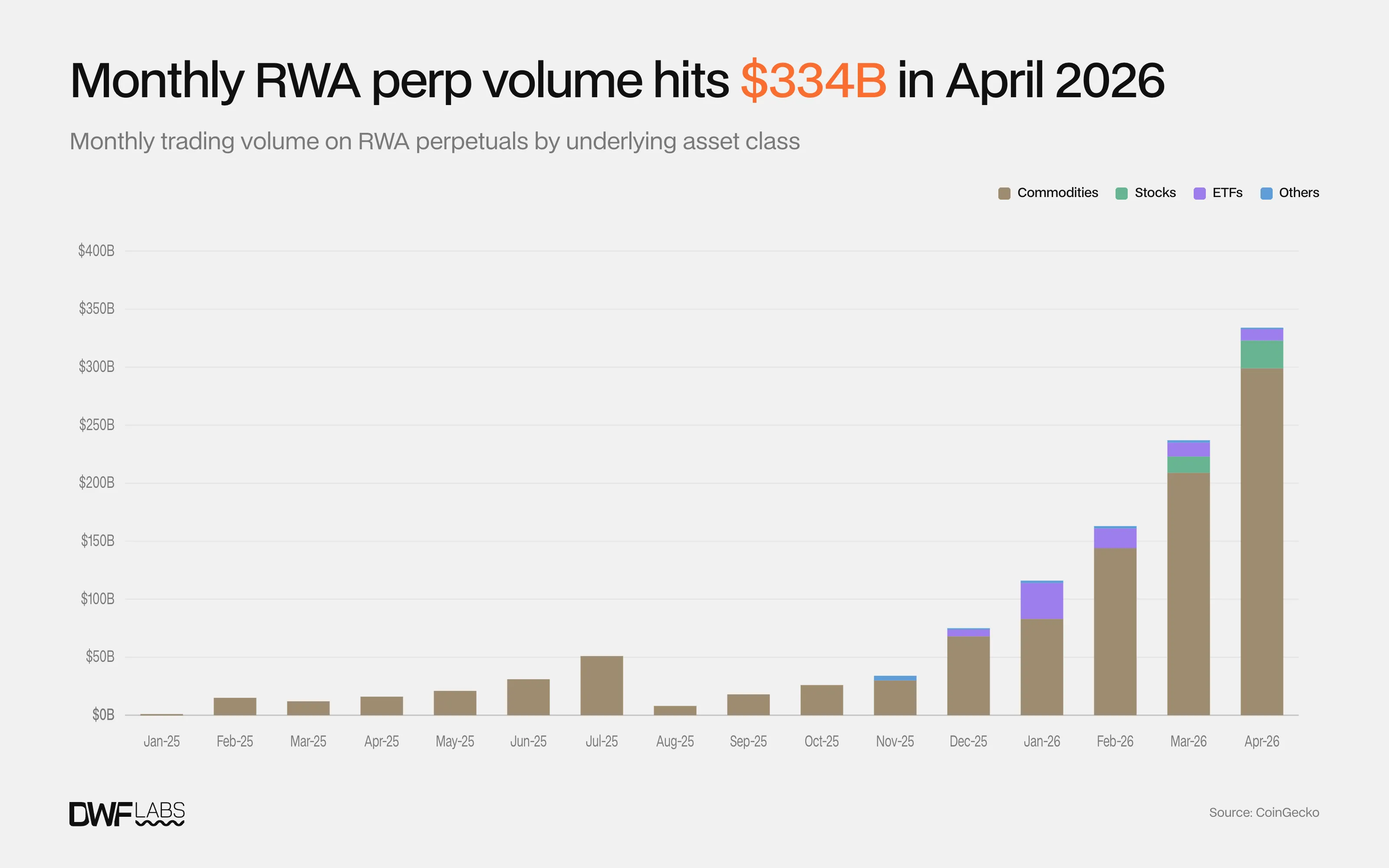
Hyperliquid's HIP-3 lets developers deploy new perpetual markets without requiring the core exchange team to list each one. That opened the infrastructure up to commodities, equity indices, individual stocks, and pre-IPO companies. Real world asset (RWA) perpetuals quickly gained traction as traders sought exposure to trending equities such as Micron and Nvidia. Monthly volume of RWA perps grew from $15B in February 2025 to $334B in April 2026.
Other decentralised platforms pursued similar real-world-asset markets, while Robinhood and Kraken began distributing perpetual or perpetual-like products to retail users in different regulatory regimes.
On May 29, 2026, the CFTC opened the door to perpetual contracts and 24/7 trading in the United States. Coinbase, Kraken and Kalshi are the first to operate fully legal and compliant perpetual exchanges in the country.
The same day, CME moved its entire crypto futures and options suite to continuous trading on Globex, interrupted only by a two-hour maintenance window on Saturday mornings and a two-minute pause on weekdays. The exchange had processed a record $3 trillion in crypto notional volume during 2025. Now, one of the oldest and most established derivatives venues in the world was adopting the trading schedule pioneered by crypto markets.
The more consequential expansion was into assets that did not yet have an efficient public market.
Outpricing bankers
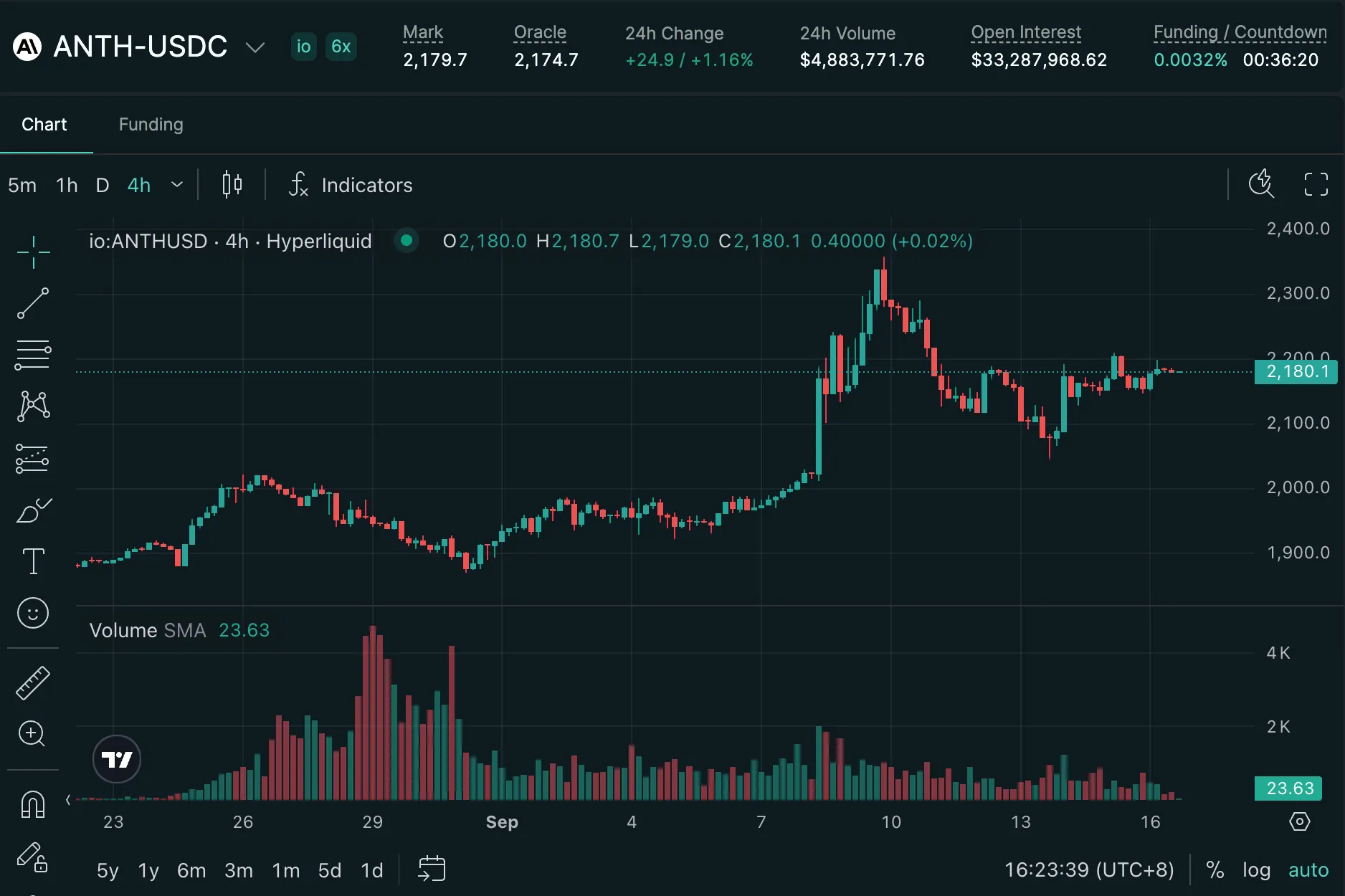
Cerebras's bankers priced its initial public offering at $185 per share. The stock opened at $350. In the final hour before trading began, a perpetual contract on Cerebras changed hands at $354.54—approximately 1.3% above the eventual opening price and 92% above the bankers' price.
SpaceX provided another test. Elon Musk set a flat price of $135 per share in June 2026. A SpaceX perpetual traded at a volume-weighted average of approximately $155, close to its $150 open.
Neither contract discovered its price from nothing. What the contracts did was aggregate that scattered information continuously and publicly. In the case of Cerebras, the resulting price proved far more accurate than the closed book-building process run by its banks.
Perpetual futures had arrived at the territory Shiller originally imagined: markets capable of producing continuous prices for assets that were difficult, restricted, or impossible to trade directly.
What comes next
The instrument's evolution points toward these developments.
Perpetuals for everything
Private companies, emerging-market equities and new asset classes such as compute all share the conditions that made Shiller propose perpetual futures in the first place: their value changes continuously, while the underlying asset trades infrequently or through fragmented markets.
Pre-IPO perpetuals have already shown what this can look like. They pull scattered private-market transactions, investor expectations and public signals into one continuously traded price. Permissionless infrastructure such as HIP-3 lowers the cost of creating these markets further. A developer can define the contract, oracle and risk parameters without waiting for the core exchange to approve every listing. The likely result is a long tail of perpetual markets appearing before conventional futures exchanges would consider them commercially viable.
Products built on top of perpetuals
Ethena is the clearest example. USDe is a yield-bearing stablecoin whose yield is made possible by perpetual futures funding rates. Ethena backs USDe with crypto assets and offsetting short derivatives positions. When demand for leveraged longs makes funding rates positive, those short positions receive payments that can be passed through to USDe holders as yield. We expect to see more products built on top of perpetuals for users, to offer yield, hedging or financial opportunities.
Adoption into more frontends/platforms
The first generation of perpetual traders went directly to specialized crypto exchanges. The next generation will trade it inside alternative platforms.
That distribution shift has already started. Robinhood and Kalshi have added perpetual or perpetual-like products in different jurisdictions. Any platform can integrate the infrastructure layer of an exchange while controlling the interface, customer relationship and surrounding products themselves.
The largest perpetual exchange of the next decade may therefore look less like a consumer platform and more like a liquidity layer embedded across hundreds of applications. That would complete the instrument's migration: from an academic proposal, to a crypto-native trading product, to infrastructure that most of its eventual users never need to see.