The Evolution of Prediction Markets
Updated On 4 September 2026
Published On 6 August 2026

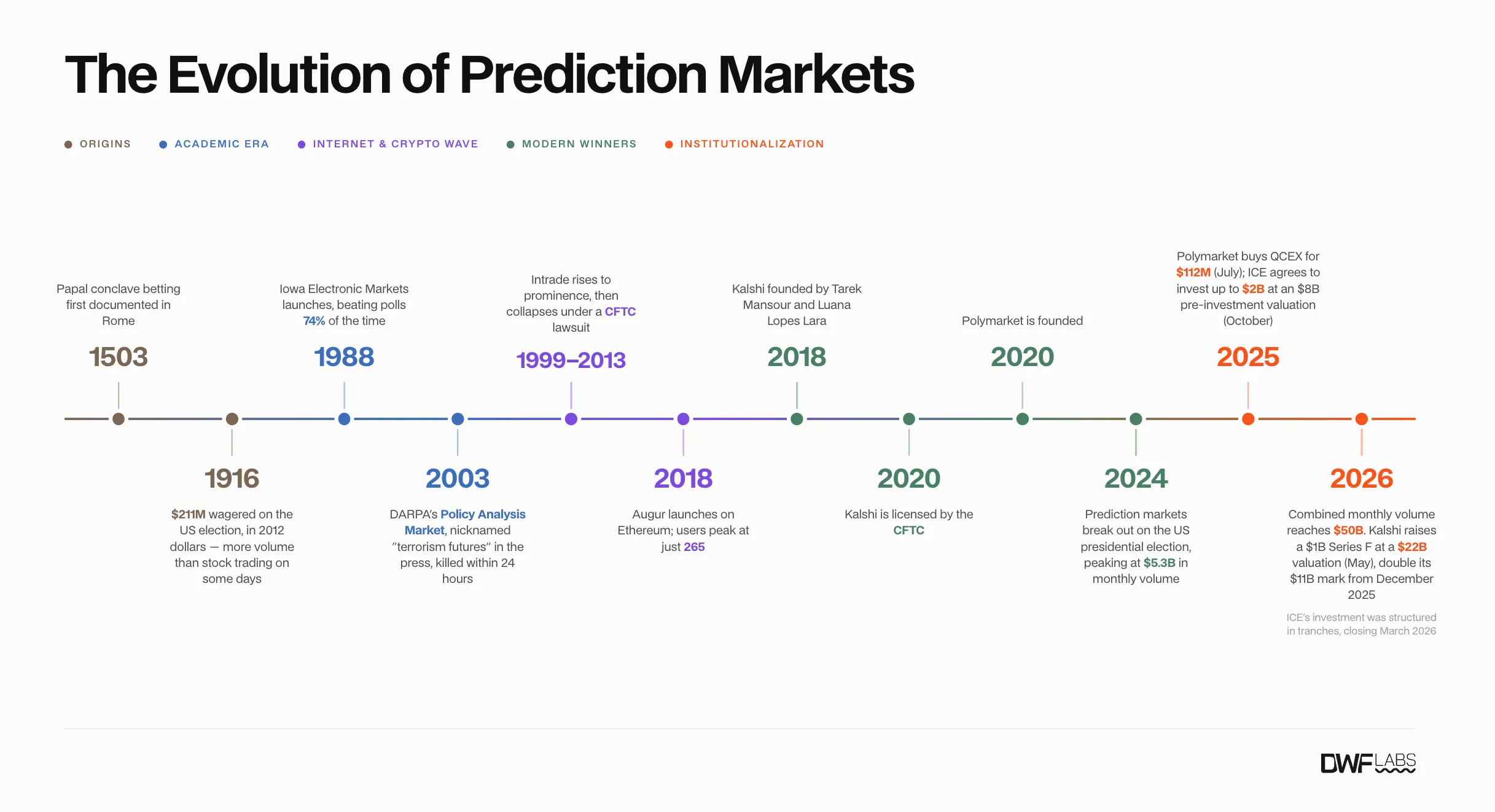
From as early as 1503, the Romans were betting on who the next pope would be. By 1916, Americans were wagering roughly $211 million in 2012 dollars on a single US presidential race, all of it in New York's organized betting markets. On busy days, election betting outran stock trading on the Wall Street curb exchange.
People have priced uncertain outcomes for money since the Renaissance, and the markets have been surprisingly good at it. So why did it take so long for successful prediction markets to emerge, and how did Kalshi and Polymarket finally break through? Here's the story of prediction markets, and where we think they're headed.
What are Prediction Markets?
A prediction market lets people trade shares on a future event's outcome, priced between $0 and $1 as the market's live estimate of the odds. Unlike a sportsbook, you aren’t locked into a position until resolution. Instead, you’re able to enter or exit whenever you want as the odds shift based on market movements. In theory, prediction markets can become information markets on everything: the odds of an interest rate hike, how many Grammys Taylor Swift will win, the temperature in Paris on February 18.
Theoretical Foundations and Early Struggles
1988 was the foundational year for modern prediction markets. Robin Hanson, widely known as the godfather of the field, started writing the first academic theory of information markets and idea futures. The same year, three professors at the University of Iowa built the Iowa Electronic Markets. Across five election cycles, the IEM's odds beat the polls 74% of the time, backing Friedrich Hayek's 1945 argument that markets are the most efficient way to aggregate the wisdom of the crowd.

Despite that early proof of concept, the 2000s and 2010s were riddled with failed attempts. DARPA shut down its Policy Analysis Market within a single day in July 2003, after two senators deemed the Hanson-designed project a market for betting on assassinations. Congress banned the Hollywood Stock Exchange from becoming a real-money movie futures exchange. Intrade operated out of Dublin for over a decade until the CFTC sued in 2012 for offering unregistered options to US persons. It collapsed by March 2013.
Crypto looked like the fix. The launch of Ethereum's mainnet gave founders programmable infrastructure to build on, and decentralization and censorship resistance looked like exactly what prediction markets needed to succeed. But a different set of problems emerged. Users of Augur (2018) faced prohibitive Ethereum gas fees and poor UX. It peaked at just 265 users, then collapsed to 37 within a month.
Problems that Plagued Prediction Markets
The most common explanations for the pre-2024 graveyard are regulatory climate and poor execution. Teams underestimated regulatory scrutiny and didn't focus enough on UI/UX. But those reasons alone don't cover the core structural issues that prediction markets face. The sharper case came from Nick Whitaker and J. Zachary Mazlish in a widely read 2024 Works in Progress essay.
There are three core participant types that every market needs in order to sustain itself:
- Savers wanting long-term returns to build wealth
- Gamblers seeking excitement and thrill
- Sharps looking to profit on mispricings using their superior analysis
Prediction markets in their most basic form fail to attract any of them. They're zero-sum (negative-sum after fees), so savers ignore them entirely. Savers need positive sum markets to grow their wealth. Most real-world questions resolve too slowly and are too niche to excite gamblers, who overwhelmingly prefer fast, quick resolutions. Without saver or gambler volume to trade against, sharps have no liquidity worth entering for. The market collapses into sophisticated traders trading against each other, a real-world version of the no-trade theorem: if everyone is rational, nobody wants to take the other side.
Market structure aside, most topics in the world aren't that exciting to most people. Without volume, there's little incentive for sharps to enter and battle it out for a small potential gain. There are exceptions, of course, like sports and politics. Whitaker and Mazlish concluded that without subsidies, prediction markets on everything don't scale.
How Prediction Markets Finally Broke Through
Yet somehow, despite all the valid criticism, prediction markets formalized themselves as a real product. After breaking out during the 2024 US presidential election, their odds are quoted everywhere as sources of truth. The New York Times cites them, CNBC broadcasts them, and Bloomberg built them directly into the terminal. Teams in the category have raised over $5 billion, with funding accelerating over the past 18 months.
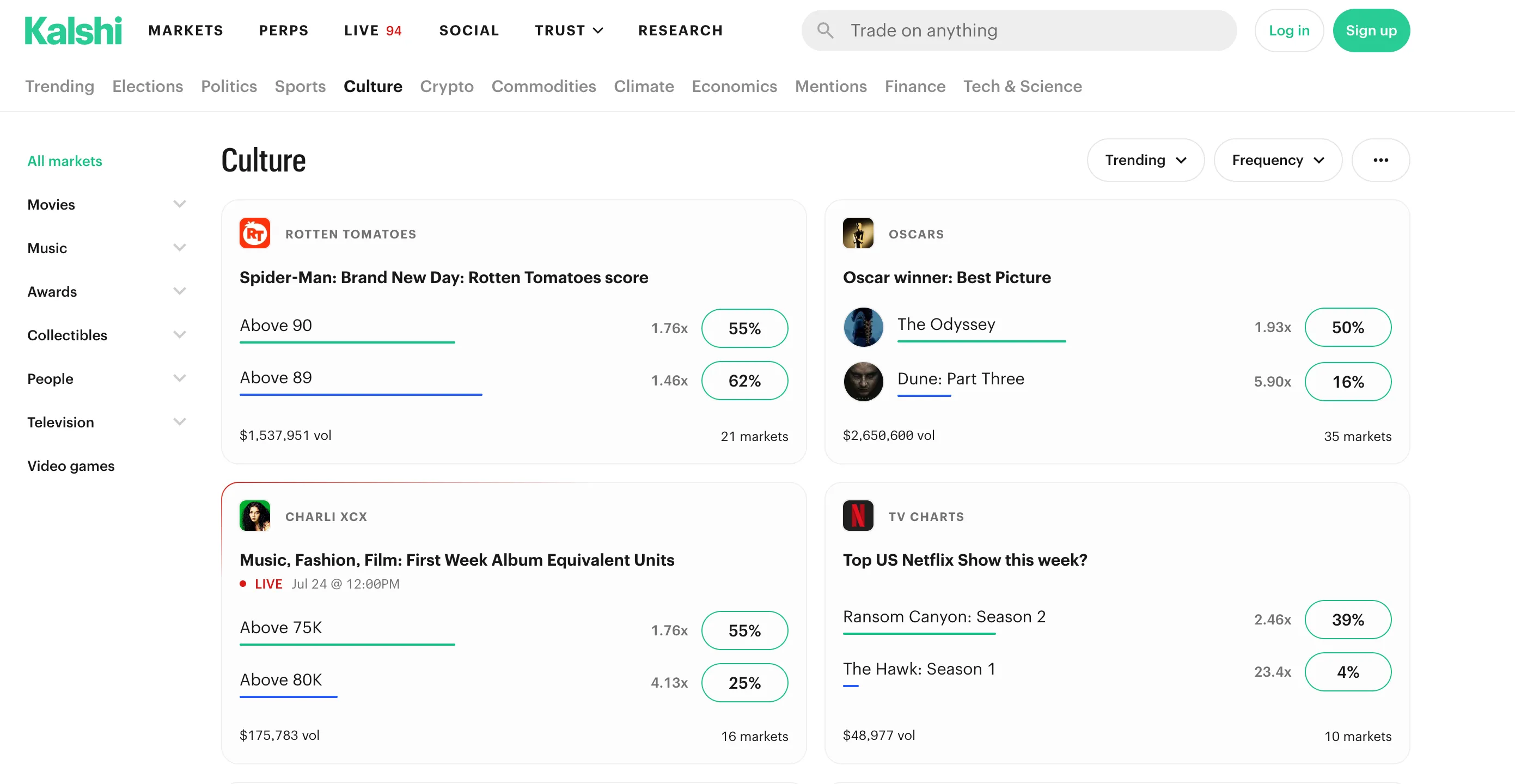
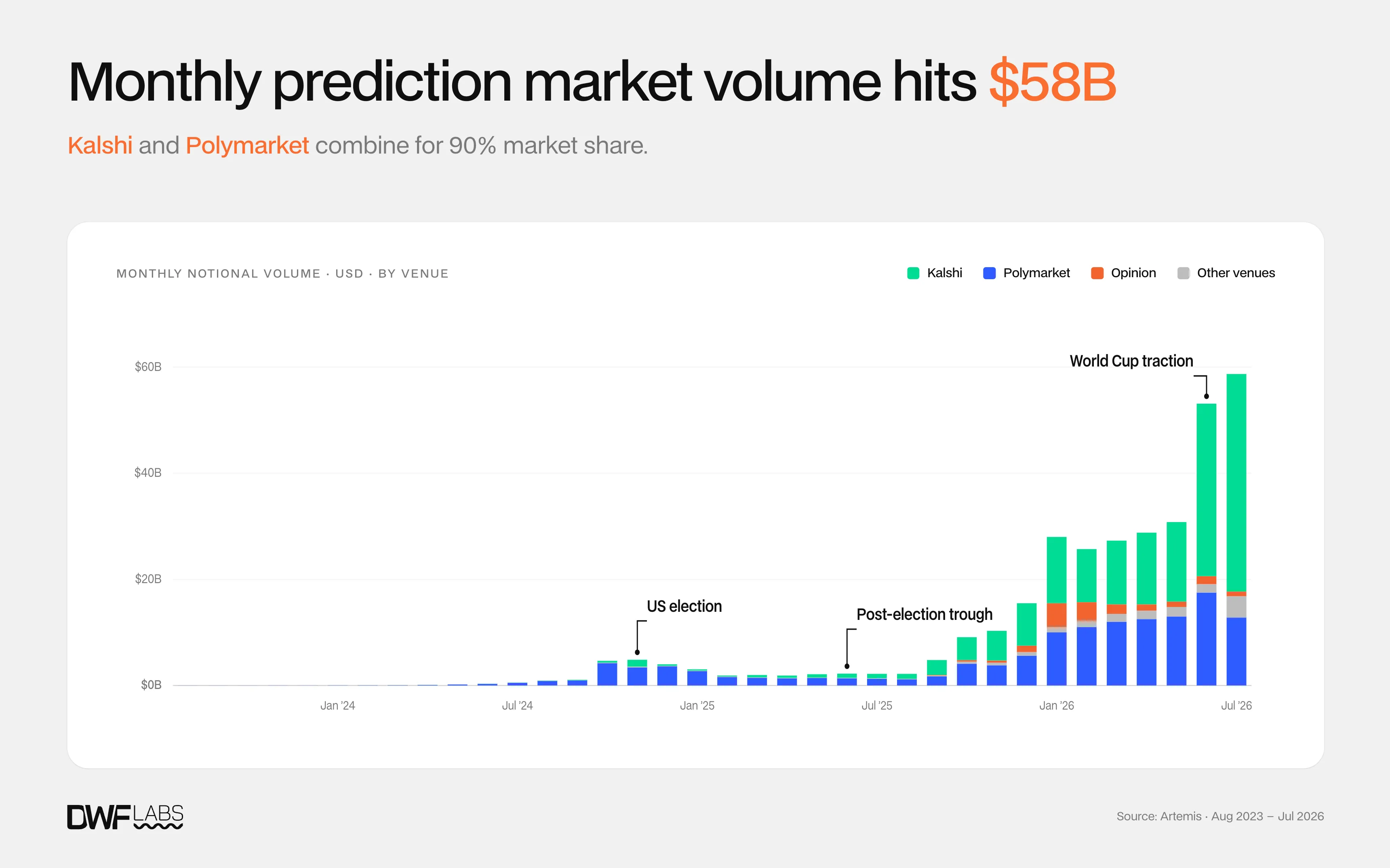
Even if you don't follow the space, you've probably heard of the two companies driving the breakthrough: Polymarket and Kalshi. Together they account for over 90% of all volume as total industry monthly volumes cross $58B.
Polymarket
Polymarket was founded in 2020 by Shayne Coplan, an NYU dropout who'd bought Ethereum in its 2014 ICO and emailed Robin Hanson in 2019 about bringing prediction markets to life. He launched from a Lower East Side apartment during COVID. Advances in crypto infrastructure, like lower-cost networks and stablecoins, let Polymarket avoid the pitfalls of earlier crypto prediction markets. It runs on Polygon, an Ethereum layer-2 that cuts gas fees to fractions of a cent, and settles in PUSD (their own stablecoin), so a $1.00 payout is exactly $1.00 with no volatility risk over the life of a bet. Trading runs through a hybrid order book, matched off-chain for speed and settled on-chain for trust, giving it a centralized-exchange feel with non-custodial settlement.

Polymarket took a launch-first, figure-out-regulation-later approach, which gave it more freedom and speed than competitors from the same generation. It gained early momentum during the 2020 presidential election, hitting roughly $26M in monthly volume, and kept growing on pandemic and pop-culture related markets.
Eventually its lack of regulatory approvals caught up with it. The CFTC fined Polymarket $1.4 million in January 2022 and ordered it to block US users. Compliance became the priority afterward: it geofenced America, hired a former CFTC chairman as an advisor, and kept operating internationally. The platform saw roughly $73M in trading volume in 2023, tiny compared to what it facilitates now, but enough to survive the broader crypto winter.
Then came the 2024 US presidential election. The lightning-in-a-bottle moment. Despite being formally banned for US users, Polymarket became the cultural face of the election. Its presidential market saw roughly $3.6 billion in cumulative volume and priced Trump’s victory more accurately than the polls or pundits did. Their success and virality put prediction markets on the global stage.
A week after the election, the FBI raided Coplan's apartment as part of an investigation into whether the platform was illegally allowing US-based users to circumvent the 2022 restrictions to trade on the international site. By July 2025 the DOJ and CFTC had closed the investigations without charges. Days later Polymarket bought QCEX, a CFTC-licensed exchange, for $112 million. In October, Intercontinental Exchange, the parent company of the New York Stock Exchange, agreed to invest up to $2 billion in Polymarket at an $8 billion pre-investment valuation, with ICE also becoming a global distributor of Polymarket's event data. The QCEX acquisition let it re-enter the US in December 2025.
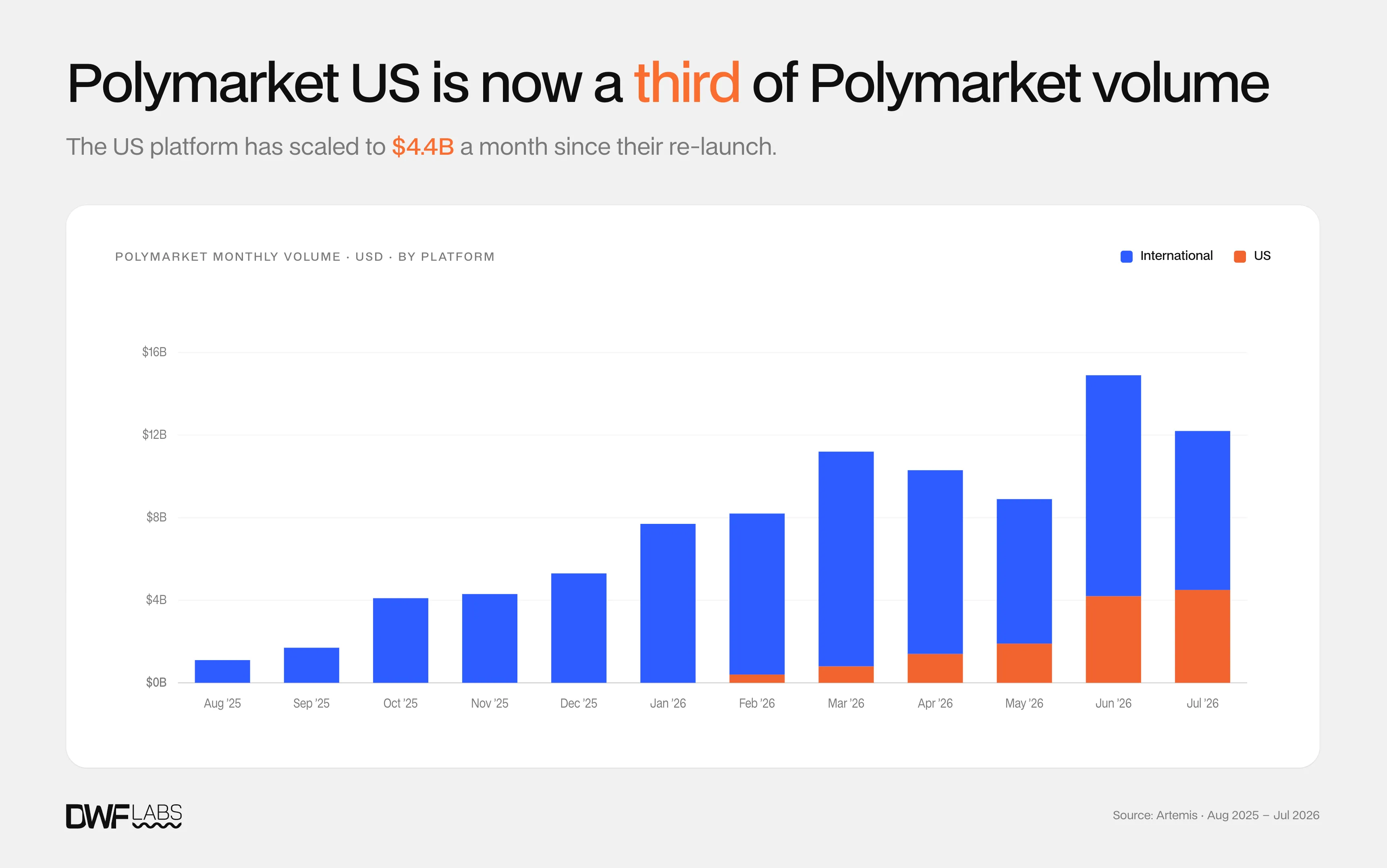
Sports, global, and geopolitical events fueled steady growth after the election spike cooled off. As of July 2026, Polymarket has facilitated over $111.9B in cumulative volume across 707.7M trades. It was the clear leader in 2024 before Kalshi took over.
Kalshi
Kalshi made the opposite bet from day one. Tarek Mansour and Luana Lopes Lara, both MIT graduates, founded the company in 2018 (Lara is a former professional ballerina who danced Swan Lake before switching to markets). They bet that regulatory compliance from day one would matter more than speed.

The founders spent nearly two years waiting on approval before launching. In November 2020, the CFTC approved Kalshi as a Designated Contract Market, the first exchange federally regulated to list event contracts as derivatives. That license became the basis for Kalshi's core legal argument: federal law preempts state gambling law. Kalshi went live in July 2021.
However, being licensed created its own set of problems. It meant Kalshi was slow to list new, popular events, and strict KYC requirements added a second drag on growth. The real kicker was having their proposal to create 2024 presidential election markets rejected by the CFTC. The single biggest catalyst in the industry's history, and they weren’t allowed to participate.
Kalshi sued and won. In September 2024 a federal judge ruled the CFTC had exceeded its authority: elections are neither unlawful nor gaming. Kalshi resumed election trading about 32 days before the 2024 vote. That delay, plus a lack of international users from strict KYC, cost it mindshare and market share against Polymarket. Kalshi saw only about $500M in election volume, compared to $3.6B on Polymarket.
The compliance bet started paying off after the election. Robinhood launched its first prediction market product in partnership with Kalshi. Bloomberg integrated Kalshi's data directly into the Bloomberg Terminal. Both deals were possible because of Kalshi's regulatory standing.
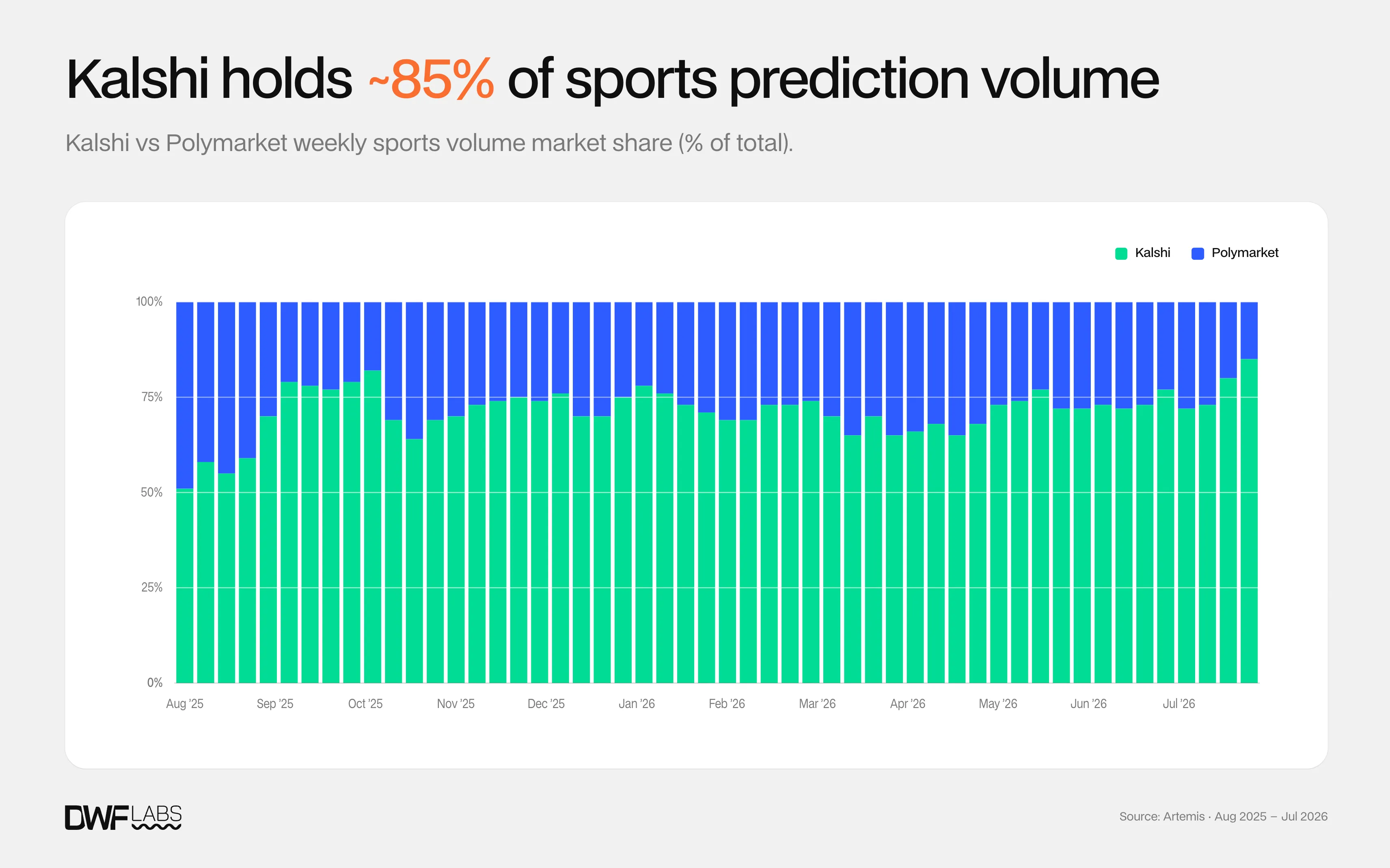
From 2025 to 2026, Kalshi doubled down on markets outside politics. Sports became its biggest category, driven by viral marketing moments. The "Knicks in four" chant during the NBA Finals, filmed at a Kalshi street interview, racked up tens of millions of views. The team parlayed that momentum into the World Cup, running ads featuring Timothée Chalamet, Lionel Messi, and Luka Modrić.
The platform facilitated $27B in volume from three million users during the tournament. As of July 2026, Kalshi has facilitated over $155.7B in cumulative volume from over 982.6M trades, putting it ahead of Polymarket as the category leader.
Widespread Distribution
The success of both leaders has led exchanges and brokerages across the industry to launch their own prediction market offerings. Many took the launch-fast route, testing demand by bolting an existing platform onto their app. Coinbase and Interactive Brokers went the aggregation route instead, pulling liquidity and markets together across multiple venues. CME Group built its own product from day one. Robinhood did a systematic approach. It started by routing trades through Kalshi, then built its own infrastructure once demand became clear. They launched their CFTC-licensed exchange, Rothera, in June 2026. That bet paid off fast. Robinhood's event contracts revenue hit $156 million in Q2 2026, up more than 10x year-over-year, overtaking its own crypto trading revenue ($100 million).
Have the Structural Problems Been Solved?
Kalshi and Polymarket solved the execution failures: regulatory strategy, low fees, consumer-grade UX. Whether they solved Whitaker and Mazlish's deeper demand problem is a separate question.
Gamblers: partially, but still far from markets for everything. Sports markets were always going to work. The only question was whether prediction markets could pull volume away from existing sportsbooks, and they did. Sports drives most of the volume year to date at $120B. Parlays have been a major driver of that growth. Introduced on Kalshi in September 2025 at under 3% of volume, they've since grown to roughly 38% of total volume as of July 2026. Crypto price predictions sit right behind sports at $22.1B. Politics has expanded past elections. Military and geopolitical conflict markets hit $2.76B, narrowly ahead of US election markets at $2.73B, and together with international elections the broader politics category exceeds $10.2B. Culture markets (music, film, celebrity) crossed $2.9B. Economics markets on Fed rate decisions and inflation hit $2.1B. Volume is growing across a wide set of categories. Still far from the grand vision of having thriving markets for everything, but meaningful progress has been made over the last 12 months.
Sharps: partially solved with the help of incentives. Sharps need volume and counterparties besides other sharps. At $120B in sports and $22B in crypto, these markets are starting to sustain that. Susquehanna joined Kalshi as a market maker in 2024, then set up a joint venture with Robinhood for prediction markets. Jump Trading took equity stakes in both platforms in exchange for providing liquidity, while Citadel is evaluating whether to get involved.
Savers: no. Prediction markets are still zero-sum, and capital locked in a bet forgoes what it could earn in treasuries or elsewhere.
The Next Era of Prediction Markets
The next era moves prediction markets from niche platforms toward infrastructure for pricing global information. New markets create room for new mechanisms.
1. Bespoke Hedging
- Businesses are able to hedge specific risks that traditional finance and insurance can't cover. For example, an ice cream shop could hedge against a cold summer. Such hedging wasn’t possible before as traditional insurance firms wouldn’t offer such coverage, since they're too niche to underwrite profitably.
2. Moving Beyond $0 to $1 Pricing
- Perpetual Markets: Continuous markets about anything. Take inflation. A binary market forces you to bet on fixed outcomes, like "will inflation be above 3.1%?" Perpetual markets give you the ability to long or short the rate of inflation itself.
- Combinatorial Markets and Futarchy: Markets that price the relationship between two events instead of one, like "what would Tesla's price be if Elon Musk quits" or "what would the price of oil be if the US invades" By having markets each pricing a variable, we would have more accurate gauges of the value of any asset. Futarchy takes this further, using conditional markets to inform governance and policy decisions: pass the policy the market says produces the better outcome.
3. AI Agents as Truth Seekers
- 24/7 Research: Future markets will likely run on AI agents that research and trade around the clock.
- Discerning Truth: These agents could act as automated truth detectors, scanning Telegram channels and social media to find ground truth faster than any human pundit.
4. A Data Layer for the Media
- News Integration: Deals with CNN and CNBC point to a deeper symbiosis with legacy media, where markets extend coverage from what happened to what's about to happen next.
- Longtail Expansion: Markets scale to the longtail, pricing everything from local neighborhood events to niche cultural trends like tech layoffs or Taylor Swift album performance. Although demand will likely depend on inculcating a shift in consumer behavior from just watching the news to also betting on outcomes.
5. Solving the Lack of Savers Problem
- Yield-Bearing Collateral: Instead of posting idle USDC, traders can post yield-bearing assets like sUSDe or tokenized T-bills as margin. Ethena's sUSDe alone has paid 4-30% APY over the past two years by capturing perpetual funding rates, and it already plugs into Aave, Pendle, and Morpho as collateral. If prediction markets accept the same collateral, a saver's capital keeps earning yield while it backs a position, rather than sitting dead until the market resolves.
- Money and DeFi Legos: Structured products could be built on top of prediction markets, either bundled with another asset or used as collateral to borrow against. If an outcome can be bundled with a yield-bearing asset or used as loan collateral, the zero-sum bet stops being the only return on that capital.