Eyes on the Market, Volume 5: The Year of Execution
Updated On 9 February 2026
Published On 14 January 2026
CLARITY Act Update
In the next few weeks, the Senate Banking Committee will vote on the CLARITY Act - the most consequential crypto legislation since the GENIUS Act became law last July. As Chairman Tim Scott put it: "After months of serious, bipartisan work, it's time to move this forward."
The bill would finally resolve the decade-long SEC-CFTC turf war, clarifying which digital assets are securities and which are commodities. If it passes the committee, it moves to the Senate floor, then back to the House, and it could land on President Trump's desk by March. If it fails, the 2026 midterms could push another attempt back by years.
As Bloomberg Law stated last week:
"The hard work of turning rules into meaningful compliance and functional oversight is just beginning. Companies and practitioners should expect 2026 to be less about crafting new regulations and more about refining, connecting, and operationalizing the ones in place."
The stakes are high. Coinbase has warned that reopening the stablecoin rewards debate "only creates uncertainty and risks the future of the US Dollar as commerce moves onchain."
Goldman Sachs published a note last week calling regulatory reform "the biggest catalyst for institutional crypto adoption." The bank's survey data shows 35% of institutions cite regulatory uncertainty as the main barrier to entry - a barrier that could dissolve on Wednesday.
Bitcoin's "Boring" Consolidation
Bitcoin has spent the past several weeks grinding sideways around $90,000, frustrating bulls and bears alike. The Crypto Fear and Greed Index remains stuck in cautious territory. ETF outflows hit $400 million in a single day last week.
But analysts see a familiar pattern emerging. CoinDesk noted that Bitcoin's current consolidation "closely mirrors the April 2025 range that set the stage for the record run above $126,000." CF Benchmarks' Gabe Selby expects BTC to hit $102,000 this year, driven by two catalysts: institutional adoption and Fed rate cuts.
"A 'Goldilocks' environment is emerging that gives the Fed room to deliver additional rate cuts in 2026," Selby told DL News. "Overall economic activity remains resilient."
The bigger shift is structural. Grayscale's 2026 outlook argues we're entering "the dawn of the institutional era" - where slow-moving capital from pension funds, sovereign wealth managers, and advisory platforms finally arrives. Less than 0.5% of U.S. advised wealth is currently allocated to crypto. That number is expected to grow significantly as platforms complete due diligence and build model portfolios. In 2025, Digital Asset Treasuries gained momentum across corporations in the U.S., and are expected to continue this growth as corporate investors seek alternative investments through market volatility.
Gold Breaks $4,600 - And Takes Tokenized Assets With It
While Bitcoin consolidates, gold keeps setting records. Spot gold hit $4,600 an ounce for the first time on Monday, extending a rally that's already delivered 6% gains in 2026 alone – on top of last year's 60%+ return, the best since 1979.
The catalysts are familiar: geopolitical flashpoints, a weakening dollar, and fresh uncertainty around Federal Reserve leadership. HSBC said momentum could carry prices to $5,000 in the first half of the year.
What's different now is where gold flows. Tokenized gold's market cap sits at $3.6 billion today - up 260% from $1 billion a year ago. The sector has matured from a niche experiment into functioning infrastructure. DeFi protocols accept gold tokens as collateral. Yield-bearing products like Kinesis delivered 6.24% annual returns in 2025. Institutional treasuries are accumulating: DL Holdings announced a $100 million Tether Gold strategy; Aurelion Global became the first NASDAQ-listed company to hold digital gold on its balance sheet.
As one analyst stated: tokenized gold is no longer just a store of value - it's "an active utility asset within the crypto ecosystem."
At DWF Labs, we believe RWAs will be an integral part of the crypto market, and are actively expanding our operational footprint at the intersection of capital markets and real-world assets through our gold trading arm.
RWAs: From Pilots to Production
Real-world asset market value quietly crossed $20 billion in total value, according to Securitize. Tokenized U.S. Treasuries alone account for $9.1 billion - still a tiny fraction of the $28 trillion Treasury market, but growing fast.
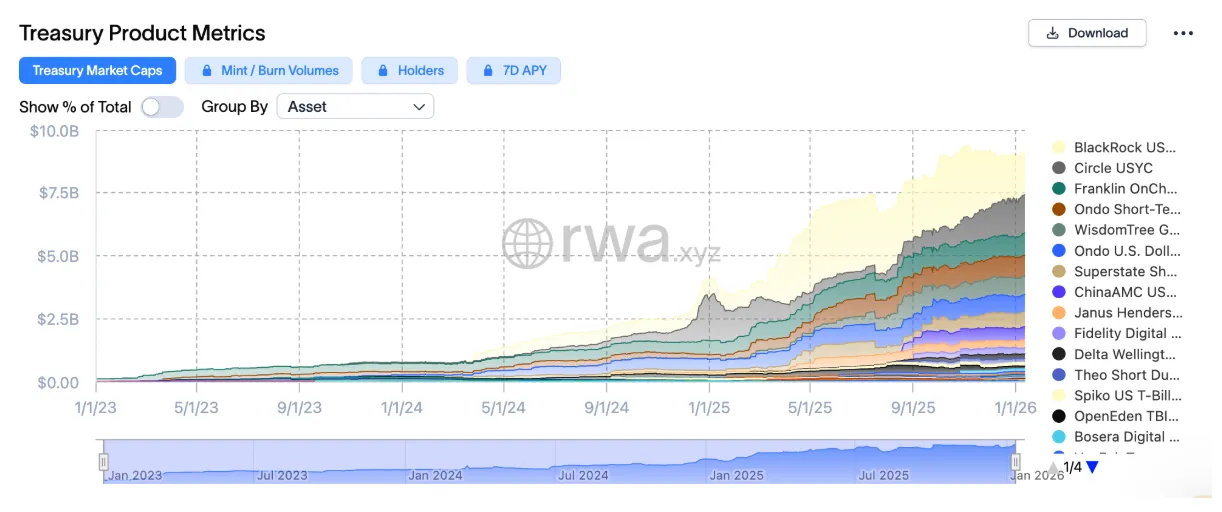
The narrative has shifted. Industry executives say 2026 is about moving "from pilots to large-scale, production-ready products." BlackRock's BUIDL fund has grown to nearly $2 billion in assets. JPMorgan launched its first tokenized money-market fund on Ethereum. The SEC issued a no-action letter allowing the Depository Trust Company to run a three-year pilot for tokenized settlement services.
Ethereum remains the center of gravity, hosting roughly $12.5 billion in tokenized RWAs - about 65% market share. But the real story isn't which chain wins. It's that traditional finance is building on-chain infrastructure at scale, and the integration is accelerating. Both retail users and consumers look towards investments outside traditional finance. RWAs have seen consistent growth in the past year, with the on-chain value of RWAs tripling in 2025.
"The next phase is about collateral usability," said Artem Tolkachev of Falcon Finance. "Institutions don't just want tokenized assets sitting in isolation."
The Bigger Picture
The throughline connecting these stories isn't price action - it's plumbing.
Stablecoins are becoming regulated payment rails. Gold is becoming programmable collateral. Treasuries are settling on Ethereum. Banks are filing applications to issue tokens. The infrastructure that connects crypto to traditional finance is being built in plain sight.
Grayscale expects bipartisan market structure legislation to become U.S. law this year. If that happens, the question shifts from "will institutions adopt crypto?" to "how fast can they deploy?" Further adoption of crypto depends on external application development that taps into deeper liquidity, offers more use cases, and provides better convertibility.
The real risk in 2026 isn't a temporary price correction. It's watching the rails get built and assuming they don't matter – then looking back a few years from now and realizing you missed recognizing a structural shift behind just another headline.