How Tokenized Gold Turns into a Blueprint for the Commodities Market
Updated On 31 July 2026
Published On 4 March 2026
Summary
- Total trading volume for tokenized gold surged to $178 billion in 2025, making it the world’s second gold investment vehicle, only behind SPDR Gold Shares ($GLD).
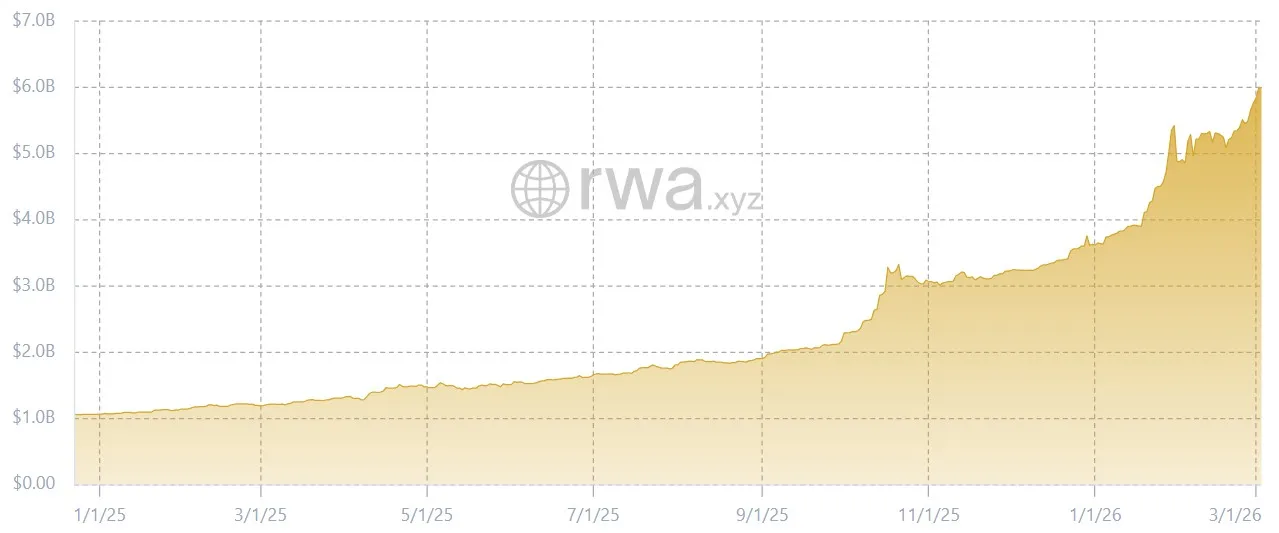
- Tokenized gold market cap has hit $6 billion by early March 2026, up about one-third since year start. $XAUT and $PAXG account for about 97% of supply.
- A surge in trading activity promotes further integration of tokenized gold into the core crypto market infrastructure, including CEXs and DeFi. There’s also a shift in traditional markets: on-chain gold trading increasingly drives weekend price discovery and may influence “CME Gap” opens.
- Tokenized gold also adds various utility advantages over TradFi instruments, including new yield and collateralization opportunities. In particular, Falcon Finance accepts $XAUT for minting $USDf and offers $XAUT staking at 3-5% APR.
- Overall, tokenized gold creates a blueprint for a broader tokenization of other commodities like oil, despite institutional hurdles in regulation, custody, and issuer concentration.
Setting the Stage
It’s no secret that the interest for tokenized gold has drastically surged in 2025. According to a recent report from CEX.io, total trading volume reached $178 billion in 2025, with 70% of that in Q4. This made on-chain gold the 2nd largest investment vehicle globally, behind only SPDR Gold Shares ($GLD).
But 2026 has already rewritten those achievements. In just 2 months into the new year, the total market cap of tokenized gold jumped to almost $6 billion, adding over 30% since the start of the year. The two undisputed leaders, $XAUT and $PAXG, dominate the sector, holding 97% of the total market cap, with the closest contenders such as $PGOLD and $XAUM far behind.
This means that capital inflows into on-chain gold are immense, and new all-time-highs are just a matter of time.
Tokenized gold is a highly liquid asset, increasingly becoming a major part of the crypto trading infrastructure. Not only are both $PAXG and $XAUT represented in spot sections of all major exchanges, they are traded in DeFi: $XAUT is available on Uniswap, and sits at the top-10 of traded tokens on Hyperliquid. Launched in January 2026 on Binance Futures, XAUUSDT and XAGUSDT contracts each exceed $500 million in trading volume daily.
The institutional appetite for gold through crypto-native infrastructure is accelerating faster than most predicted, and we at DWF Labs decided to step into this RWA market, settling our first physical gold trade in December 2025, with plans to scale into other on-chain commodities such as silver, platinum, and cotton.
Weekend Trading Pushes TradFi Toward On-Chain
The most overlooked shift that tokenized gold brought is how it changed price discovery.
Let’s start with the beginning. CME gold futures that dominate global gold trading effectively go quiet from Friday until Sunday evening, leaving roughly a full day each week where the TradFi giant doesn’t dictate prices.
However, being highly affected by outside events in economy and international relations, the gold market had a need for repricing gold without breaks, in real time. This is exactly the loophole that tokenization effectively fulfills.
Gold tokens, as well as on-chain perpetuals trade 24/7/365, so when events break on a weekend (new tariffs, central bank moves, flared up conflicts), on-chain markets become the first rail that absorbs that information.
Weekend on-chain gold trading volumes have been growing materially, and with them, the influence of tokenized gold’s prints on next session’s reopen, including legacy venues such as CME.
Historically, the “CME Gap” (the price jump between Friday’s close and the Sunday evening opening) was treated as noise. Thanks to tokenized gold, it’s turning into a measurable signal: the wider and more directional the gap, the more it suggests that the real repricing already happened on-chain.
Summing up: The commodities market is quietly voting for 24/7 functionality, and CME’s role shifts from being a major reference point that increasingly reacts to continuous markets. Price discovery is moving toward always-on markets, and tokenized gold is one of the clearest early case studies.
The forward path is coexistence with tighter interoperability: traditional venues for depth and hedging, on-chain venues for continuous discovery and settlement.
Assets with Extra Benefits
Tokenized gold trading today is still crypto-native first: market makers, crypto funds, and DeFi power users who want a macro hedge without leaving onchain rails.
Market makers are the key enablers because liquidity is what makes these instruments scalable and reliable across venues.
What’s changing in 2026 is the product layer. With yield-bearing, gold-collateralized products emerging, tokenized gold starts to look like a capital-efficient collateral asset, which is exactly what pulls traditional allocators in next.
One example is Falcon Finance: it accepts $XAUT tokens as collateral for minting $USDf, which can be further staked to get a portion of protocol’s earnings. Additionally, Falcon offers a staking vault for $XAUT: you can lock your gold tokens for a set period to get a 3-5% APR, all without the need to give up your on-chain gold.
This model proves that moving on-chain, gold has obtained new abilities as financial instruments, bringing additional value to its holders, compared to physical or TradFi wrappers.
Overall, it is worth highlighting the following advantages of tokenized gold:
- Continuous price discovery: thanks to tokenization, gold is a global macro asset influenced by events in every time zone.
- Instant settlement: tokenized gold doesn’t need lengthy settlement and clearing houses, finalizing transactions in mere minutes.
- Composability and yield generation: tokenized gold can be deposited into blockchain protocols as collateral, used for yield generation, or plugged into structured products.
- Fractional access: forget block trading or purchasing by ounces — with tokenized gold, you can buy as little as $1 worth of PAXG or XAUT, both backed by extensive physical reserves.
- Global accessibility: there’s no more need for brokerage accounts or on-site shopping, you only need an internet connection and a wallet to access tokenized gold.
Building a Universal Tokenization Case for Commodities
Tokenized gold is proving the model that, as we believe, can be transferred to virtually any other commodity and beyond.
The tokenized commodities market was slightly over $1 billion in the beginning of 2025, striving for a $8 billion by the end of February 2026, and the pace is only accelerating.
Gold leads because it has the simplest custody and verification model, but energy and agriculture present massive transformation potential given existing inefficiencies: opaque supply chains, oligopolistic structures, and high barriers to entry.
Speaking about other popular commodities, oil is a more complex case due to storage and delivery logistics, but as blockchain infrastructure matures and regulatory frameworks solidify, there’s no structural reason oil couldn't follow gold's path. The key driver is the same across all of these: markets want to trade 24/7, they want instant settlement, and they want composability. Tokenization delivers all three.
What Still Holds Institutions Back
Despite a clearly positive trend, there are still constraints to the institutional adoption of tokenized gold: liquidity, regulation, and custody, but the balance of friction is changing quickly.
Liquidity used to be the gating factor, but that’s now fading as a primary objection.
The harder constraint is regulatory clarity. Frameworks remain uneven: Europe is moving toward clearer guardrails, while the U.S. still wrestles with overlapping jurisdiction and classification questions. On the contrary, East Asian jurisdictions like Hong Kong promote themselves as fast movers on tokenization policy, creating a global patchwork that complicates cross-border compliance and internal approvals.
Then there’s the infrastructure risk institutions care about most: custody and issuer concentration. When most supply sits with a small number of issuers, it becomes a single point of failure. Broader issuer diversity, higher-standard custody options, and more transparent risk frameworks are the practical unlocks that can turn tokenized gold from a couple of dominant products into a robust institutional market.
The final barrier is more cultural: mindset. Many investors still treat “on-chain” as a separate asset category rather than a new distribution and settlement layer for the same underlying commodity exposure. That mental model is breaking, albeit slowly.
Tokens vs. ETFs and Futures
In the near future, on-chain gold complements ETFs and futures by offering what legacy finance can’t: 24/7 trading, instant settlement, composability, fractional access, and new use cases.
But as volumes scale and tokenized gold becomes a primary execution venue, not just an alternate wrapper, gold tokens will enter a direct competition.
The RWA market will likely grow from the current dozens of billions to trillions. Forecasts vary, from Standard Chartered’s $2 trillion to ARK Invest’s $11 trillion, but the baseline is obvious: tokenized gold will be too big to be ignored by the broader financial industry.
The likely end state is convergence: either tokenized gold becomes the default access layer for a growing share of flows, or ETFs and futures increasingly tokenize themselves to stay relevant.
Overall
Tokenized gold is not just a “token”. The weekend effect is probably the most visible signal: on-chain markets keep trading and repricing macro risks in real time. Instant settlement, round-the-clock trading, additional utility coming from crypto-native infrastructure — all this turns tokenized gold from just another set of tokens into the global upgrade for how gold is accessed, used, and priced, building up the perfect blueprint for the entire commodities market.