Inside x402: How a Forgotten HTTP Code Becomes the Future of Autonomous Payments
Updated On 31 July 2026
Published On 17 November 2025

Is x402 the key to unlocking the next wave of AI agents and on-chain payments? Backed by major tech firms, payment networks, and leading crypto teams, the protocol is rapidly emerging as a foundational layer for autonomous, machine-driven commerce. DWF Ventures brought together crucial details about the project, from how the protocol works to ecosystem adoption, real-world use cases, and the innovations now taking shape around it.
What Is x402?
Introduced in September 2025, the x402 protocol and foundation were established by Coinbase and Cloudflare. This initiative is aimed at reviving the long-dormant HTTP 402 “Payment Required” status code to turn it into a native payment step that allows applications, APIs, and AI agents to send and receive instant, autonomous stablecoin payments such as USDC and USDT directly over HTTP. This removes the need for subscription walls, redirects, and custom integrations, making payments feel like a seamless extension of a standard web request.
The x402 Foundation will oversee governance, ecosystem growth, and protocol interoperability. Coinbase contributes its experience with stablecoin infrastructure, while Cloudflare brings global-scale networking and is already integrating x402 into its “pay per crawl” beta, enabling developers to fetch web data and settle payments in the same request cycle.
How x402 Works
With the goal of making online transactions seamless, x402 removes many of the familiar sources of friction: no signups, no API keys, no invoices to manage. Instead, it enables low-fee, automated payments using stablecoins on fast blockchains like Base and Solana.
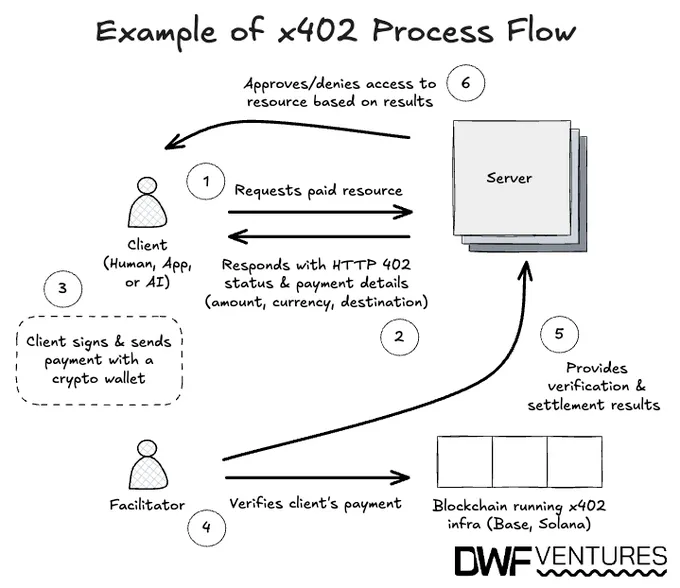
The flow is straightforward:
- A client (human, application, or AI agent) sends a standard HTTP request to access a resource that requires payment.
- Server responds with an HTTP 402 “Payment Required” status. This response includes the payment amount, currency (e.g., USDC), and the destination wallet address.
- Using a crypto wallet or built-in agent wallet logic, the client signs the transaction and sends the payment to the specified destination.
- A facilitator service checks the transaction on-chain, confirming that the client sent the correct amount to the correct address.
- The blockchain, running x402-enabled infrastructure on networks such as Base or Solana, finalizes the transaction and returns verifiable settlement data.
- The server receives the verification results and, based on them, either grants the client access to the requested resource or denies it if the payment didn’t settle correctly.
The graphic scheme of this process is depicted below:
Who Are Facilitators?
Facilitators play a crucial role in making x402 practical for real-world adoption. Their core responsibilities are to verify and settle the client’s payment, and return clear results to the server, which then decides whether to grant access to the requested resource.
Introducing a facilitator into the flow keeps the x402 protocol lean while removing operational burdens from both sides. Clients don’t need to manage complex verification logic, and servers don’t need to maintain blockchain node connections or build custom settlement pipelines. Instead, the facilitator standardizes how payments are checked and confirmed across different services.
This design brings three major benefits:
- reduced operational complexity, since neither party needs direct blockchain connectivity;
- protocol consistency, thanks to uniform verification and settlement logic;
- faster integration, allowing services to begin accepting x402 payments with minimal blockchain-specific development.
In practice, facilitators make x402 not only possible, but accessible, lowering the barrier for apps, APIs, and AI agents to participate in automated, stablecoin-powered commerce.
x402 Protocol Usage Data
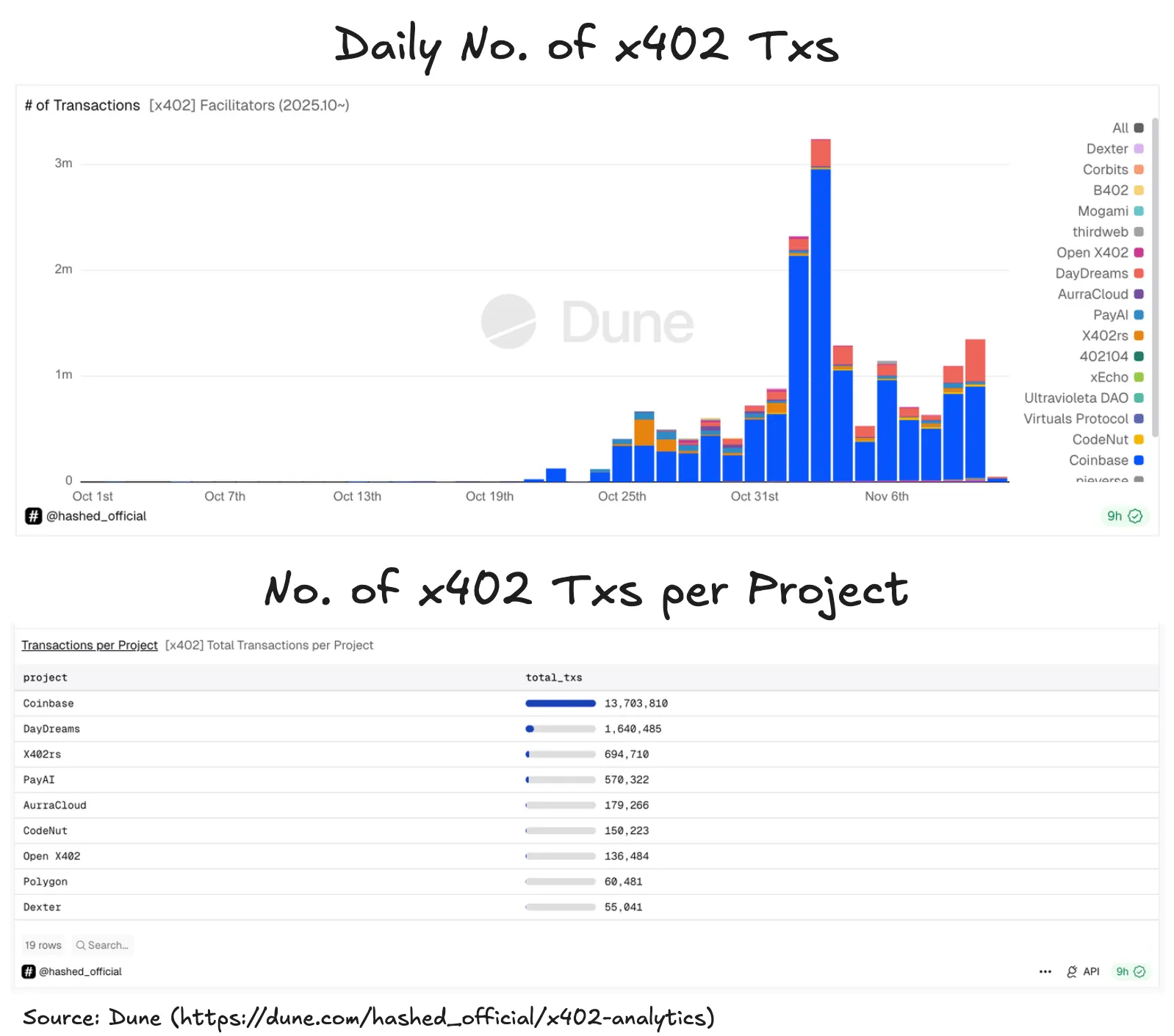
Adoption of x402 has accelerated rapidly, with total transaction counts across all projects now exceeding 15 million. A significant share of this activity comes from Coinbase, followed by Daydreams Systems and a growing list of projects integrating x402 into AI agents, data services, and web APIs. Usage also showed a clear upward trend based on onchain data about daily transaction volume.
x402 Ecosystem
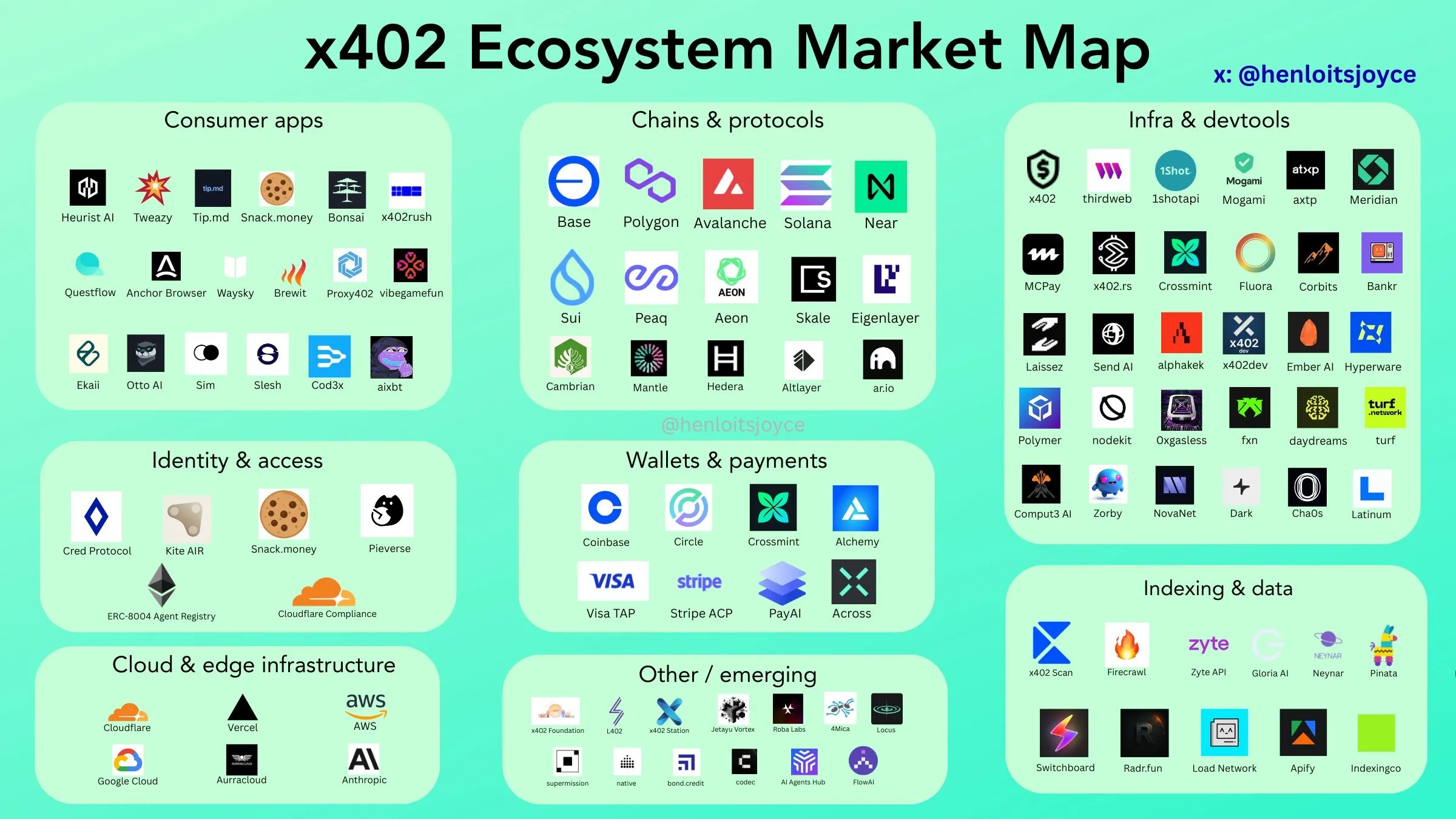
x402 has already seen adoption across a wide spectrum of platforms, tools, and applications, reflecting how broadly useful a native web payment layer can be. Researchers emphasize several categories within the x402 ecosystem:
- Consumer apps. AI tools, tipping apps, and lightweight agent interfaces using x402 for simple, pay-per-use interactions. Notable projects: Heurist AI, Tip.md, Snack.money, Brewit, aixbt.
- Layer-1 (L1) blockchains and L2 protocols that support x402 payments: Base, Solana, Polygon, Avalanche, Sui, and Near, and others.
- Infrastructure and developer tools: facilitators, agent frameworks, and SDKs that make it easy to integrate x402. Notable projects: Daydreams, thirdweb, Crossmint, Fluora, and Bankr.
- Identity and access layers for agentic or enterprise use cases. Notable projects: Cred Protocol, Cloudflare Compliance, and Pievers.
- Wallets and payments to enable stablecoin transactions and verification. Key integrations include Coinbase, Circle, Alchemy, Visa TAP, and Stripe ACP.
- Cloud and edge infrastructure to support agents, compute, and data workflows. Key participants include Cloudflare, Google Cloud, AWS, and Anthropic.
- Indexing and data tools that power pay-as-you-go scraping, data delivery, and real-time feeds. Notable projects: Firecrawl, Pinata, and Apify.
There are also projects that do not fall in any of these categories yet experimenting with x402-based agentic patterns and native workflows. Some examples include L402, Jetpay Vortex, FlowAI, and bond.credit, with the x402 Foundation serving as the ubiquitous ecosystem supporter.
The full x402 protocol ecosystem can be seen below:
Other Use Cases
x402 is already proving useful across a range of emerging real-world scenarios. One of the most immediate opportunities is pay-per-use access to resources: instead of relying on subscriptions or prepaid credits, developers can offer metered access to AI models, datasets, compute, or storage, charging only for the exact requests made. This also extends to on-demand data and signals, where applications or agents can fetch real-time analytics, market data, news feeds, or web-scraped information precisely when needed, without maintaining constant connections or long-term billing relationships.
The protocol also opens the door to creator micropayments, where tipping, pay-per-content, or small-value interactions are finally viable at internet scale. Optional identity attestations add an extra layer for creators, platforms, or agents that require trust or provenance. And in more advanced scenarios, x402 is enabling the rise of agentic commerce, where autonomous agents pay one another for data, services, or compute in real time. This machine-to-machine economy is still early, but x402 provides the payment primitive needed to make these cross-agent transactions simple, verifiable, and fully automated.
Possible Future Scenarios
x402 is well-positioned to accelerate the adoption and real utility of AI agents across multiple industries. Among some possible developments, AI-driven strategies could get monetization opportunities, whether in gaming, DeFi, or risk modeling, to offer their proprietary logic on a per-use basis without exposing underlying code. AI marketplaces become more viable as agents can seamlessly pay for access to specialized models or private datasets needed to complete complex tasks. And as agents gain the ability to transact autonomously, better cross-agent collaboration becomes a reality: an agent can outsource subtasks to other purpose-built agents, pay for their outputs instantly, and assemble higher-quality results with minimal human intervention.
Major technology and crypto enterprises, including Google, Visa, and EigenCloud have already announced plans to incorporate x402 into their systems. As more teams experiment with autonomous agents, fine-grained data access, and modular AI workflows, x402’s role as the payment primitive for these interactions will only grow. With this expanding support, the next wave of innovation is likely to come from entirely new use cases.
Future Outlook
x402 is rapidly evolving from a promising protocol into a foundational layer for automated, AI-driven commerce. In less than three months since launch, it has already demonstrated its capacity to outperform traditional payment rails, with millions of transactions processed and a wave of new applications emerging across chains and product categories. Its frictionless design, chain-agnostic scalability, and fast-growing ecosystem all signal a transformative shift in how AI agents and on-chain payments will operate across the internet.
If you are building in the x402 ecosystem, don’t hesitate to contact DWF Ventures to discuss partnership opportunities.
%20(5)-960x540.webp?prefix=media)