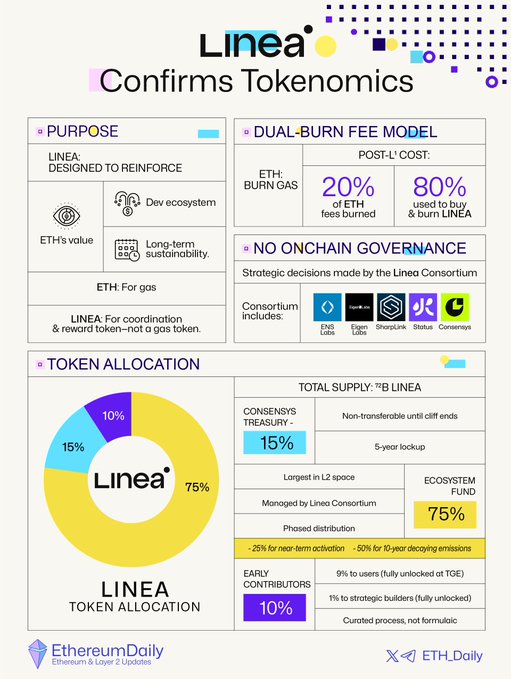
With the Token Generation Event (TGE) for Linea approaching, activity on the network has surged since August 2025, and multiple on-chain metrics are hitting fresh highs. To better understand its positioning, DWF Ventures examined what differentiates Linea from other Layer 2 (L2) solutions and which projects within its ecosystem are worth monitoring.
Linea’s Origins and Foundations
Incubated by ConsenSys, Linea is an Ethereum L2 zk-EVM rollup that enhances Ethereum’s security, scalability, and decentralization. Linea evolved from ConsenSys’s zkEVM infrastructure, a developer-friendly, zero-knowledge rollup, designed to scale Ethereum by offering faster and cheaper transaction processing while maintaining full Ethereum compatibility.
Linea delivers native integration with popular Ethereum tooling, such as MetaMask, Truffle, and Infura, enabling seamless migration of existing applications without requiring code changes. Moreover, Linea is natively available within the MetaMask Developer Portal, streamlining on-ramp, bridging, and swap functions for users, and granting developers direct access to a wide user base through MetaMask’s distribution channels.
In effect, Linea offers a seamless, scalable environment for developers while preserving Ethereum’s security model and providing users with smoother onboarding, bridging, and swapping experiences, all key to fostering broader adoption.
Exploring Linea’s Rapid Growth in Metrics
Linea’s momentum is not just about narrative; the numbers back it up. Since the beginning of August 2025, the network’s on-chain activity has skyrocketed. Daily active addresses and transaction counts have increased by more than 4x from their previous lows. Meanwhile, total value locked (TVL) has climbed to nearly $2 billion, and decentralized exchange (DEX) volumes have surged toward $800 million as of September 9, 2025. These metrics highlight the strong interest and usage the ecosystem is starting to generate.

Key Features That Set Linea Apart
In addition to its zk-proof architecture, Linea incorporates innovative economic features aimed at aligning incentives and fostering long-term protocol sustainability. These innovations span transaction fee management, yield generation, and governance, each reinforcing Ethereum’s broader vision while securing Linea’s long-term sustainability. These include:
Fee Burns and Economic Alignment
Linea is pioneering a dual-burn mechanism that directly links network activity with value creation. At the protocol level, 20% of all transaction fees paid in $ETH are permanently destroyed, making Linea the first Layer 2 to contribute to Ethereum’s deflationary supply model.
The remaining 80% of fees are used to buy back and burn $LINEA tokens. This design embeds deflationary pressure into both $ETH and $LINEA, creating a system where higher usage translates into direct economic benefits for both ecosystems. By aligning incentives between Ethereum and Linea, the mechanism strengthens $ETH’s “ultrasound money” narrative while supporting Linea’s long-term token value.
Native $ETH Yield for DeFi Participants
Linea’s Native Yield feature is designed to automatically stake $ETH bridged to the network via Lido v3’s liquid staking infrastructure (stVaults). This enables $ETH to begin earning Ethereum’s native staking rewards, estimated at 3–5% annually, without any additional action required from users.
These staking rewards are then funneled directly into Linea’s DeFi ecosystem, where liquidity providers benefit from dual income streams: Ethereum staking yields as well as protocol-level DeFi returns. By integrating this at the protocol level, Linea transforms bridged ETH from a passive asset into a productive one, enhancing both capital efficiency and liquidity across the ecosystem while eliminating user friction in managing staking manually
The Linea Consortium
Linea’s governance diverges from the common token-based voting models used by most Layer 2s. Instead, it relies on the Linea Consortium, a collective of Ethereum-aligned institutions. Founding members include ConsenSys, Eigen Labs, ENS Labs, SharpLink, and Status.
This group oversees critical decisions such as emissions schedules, ecosystem grants, incentive programs, and fund allocations. The consortium also manages the ecosystem fund, one of the largest of its kind in Ethereum, supported by a token distribution where 85% of the supply is dedicated to ecosystem development. The remaining 15% is held in the ConsenSys treasury under a five-year lock-up, signaling long-term commitment.
By anchoring governance in established Ethereum-native organizations, Linea ensures decision-making remains aligned with Ethereum’s values while fostering trust among developers, institutions, and users.
Growing Ecosystem and Notable Projects to Watch
Despite being relatively young, Linea’s ecosystem is expanding quickly across multiple verticals. Projects are emerging in areas such as decentralized exchanges, staking, lending, yield aggregation, consumer applications, AI-driven tools, launchpads, infrastructure solutions, and stablecoins. This diversity of development indicates a broad and promising foundation for growth.

Among the blockchain projects gaining traction is Etherex, a flagship MetaDEX built on Linea. Unlike traditional exchanges that split revenues across multiple stakeholders, Etherex channels 100% of trading fees directly to stakers and all liquidity fees to liquidity providers (LPs), ensuring maximum value capture for active participants. The platform also supports concentrated liquidity, allowing providers to allocate capital more efficiently within specific price ranges. By integrating Ramses Exchange v3 technology, Etherex enhances execution quality and deepens liquidity pools, positioning itself as a cornerstone for trading activity within the Linea ecosystem.
Another standout is Malda, a next-generation lending protocol designed with scalability at its core. Built on ZK Coprocessor technology, Malda offloads complex calculations to a zkVM, reducing on-chain overhead and enabling a more flexible and cost-efficient user experience. This architecture allows the introduction of customizable interest rate curves, giving borrowers and lenders greater flexibility while improving capital efficiency. For users, this translates into enhanced scalability, optimized lending markets, and lower costs, all while maintaining the transparency and security benefits of zk-based systems.
Together, projects like Etherex and Malda exemplify the kind of innovation that is beginning to define Linea’s ecosystem, demonstrating how its technical foundation can support advanced financial primitives and attract both liquidity and developers
Conclusion
Linea is still in its early stages, but its design choices suggest long-term potential. Features like fee burns, native $ETH yield, and the Consortium model distinguish Linea from other L2 networks. Initiatives such as the Linea Ignition program further fuel ecosystem expansion. For both retail users and institutions seeking secure yield opportunities, Linea is positioning itself as a compelling solution.
The DWF Ventures team is excited about the opportunities emerging within the Linea ecosystem and believes its innovative features and growing ecosystem position it well for long-term success. The team is actively seeking to support teams building on this Layer 2. If you’re working on something promising, reach out to DWF Ventures.
Disclaimer: This article is intended for general informational purposes only and does not constitute financial advice. Readers should conduct their own research and consult with a professional advisor before making any investment decisions.