The Rise of Yield-Bearing Stablecoins
Updated On 31 July 2026
Published On 18 September 2025
The total circulating market cap of all stablecoins is now close to $300 billion, marking a staggering 120% growth since January 2024. Alongside this expansion, the market has seen the rapid emergence of yield-bearing stablecoins, each with unique designs and mechanisms. This article examines the major players shaping this sector and highlights their differences.
Stablecoins: From Utility to Productivity
Stablecoins have long been the backbone of Decentralized Finance (DeFi), powering trading, lending, and liquidity provision, and serving as a crucial bridge between crypto and Traditional Finance (TradFi). They are the unit of account and settlement currency for most on-chain activity, providing stability in an otherwise volatile environment.
As of September 2025, stablecoins have moved beyond their original role of simply providing stability. A growing category known as yield-bearing stablecoins now allows holders to earn returns while keeping the benefits of price stability.
The innovation lies in their design. Instead of passively holding a token pegged to fiat, users can now access stablecoins that embed yield directly into the asset itself. These returns are sourced from a variety of mechanisms, ranging from funding rate arbitrage and derivative strategies to staking rewards, lending revenues, crypto liquidity provision, and increasingly, real-world asset (RWA) collateral such as short-term U.S. Treasuries.
This shift fundamentally changes the role of stablecoins in DeFi. They are increasingly being used as productive crypto assets, offering users an alternative to holding non-interest-bearing tokens and opening new options for both individual and institutional participants.
The Yield-Bearing Stablecoins in the Arena
While market leaders like Tether ($USDT) and Circle ($USDC) continue to dominate in terms of circulation and liquidity, the field of yield-bearing stablecoins has begun to capture their own portion of market share.
Competition is no longer just about scale but about how these tokens generate returns, manage collateral, and integrate into the wider ecosystem.
Key players in this segment include:
- Falcon Finance ($USDf)
- Aave ($GHO)
- Ethena ($USDe)
- Resolv Labs ($USR)
- Sky Ecosystem ($USDS)
- Ondo Finance ($USDY)
- Usual Money ($USD0)
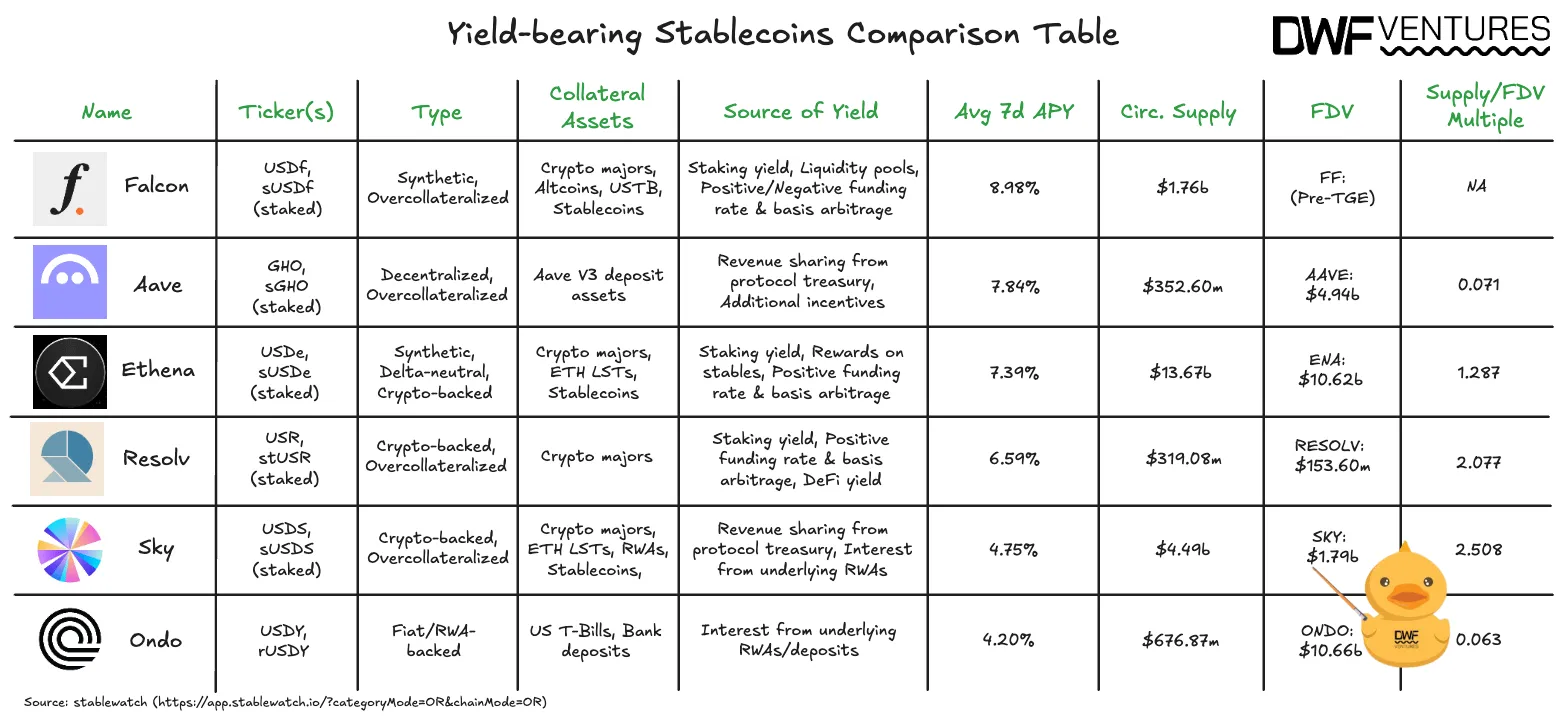
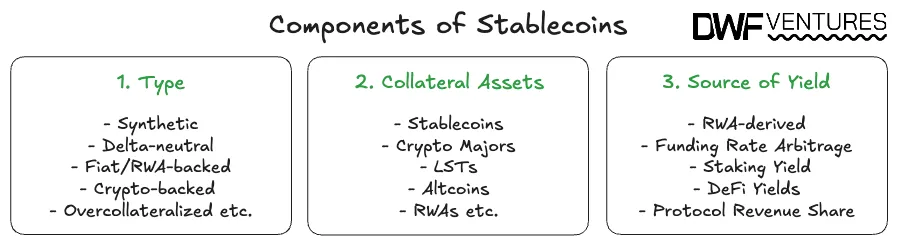
These protocols differ across several key components, as outlined in the table below:
The following sections take a deeper look at each project.
Falcon Finance: Rapid Growth with Universal Collateral
Falcon Finance’s $USDf has grown to $1.8 billion in circulating supply and 59,000 monthly active users within seven months of launch in early 2025. Despite the rapid expansion, $USDf has posted the highest average 7-day APY of 8.98% among the projects discussed here, powered by a diversified strategy set: staking, positive and negative funding rate arbitrage, and basis trading.
Falcon is positioning $USDf within a universal collateral layer: any custody-ready, yield-generating asset, crypto, tokenized real-world assets (such as Superstate’s $USTB), or fiat-linked instruments can be used as collateral to mint $USDf. This links synthetic dollars to institutional-grade collateral and liquidity, connecting on-chain strategies with off-chain financial systems.
The project’s governance token, $FF, has not yet launched. A community sale hosted on Buidlpad is underway, giving eligible retail participants the opportunity to purchase tokens at valuations of $350 million or $450 million.
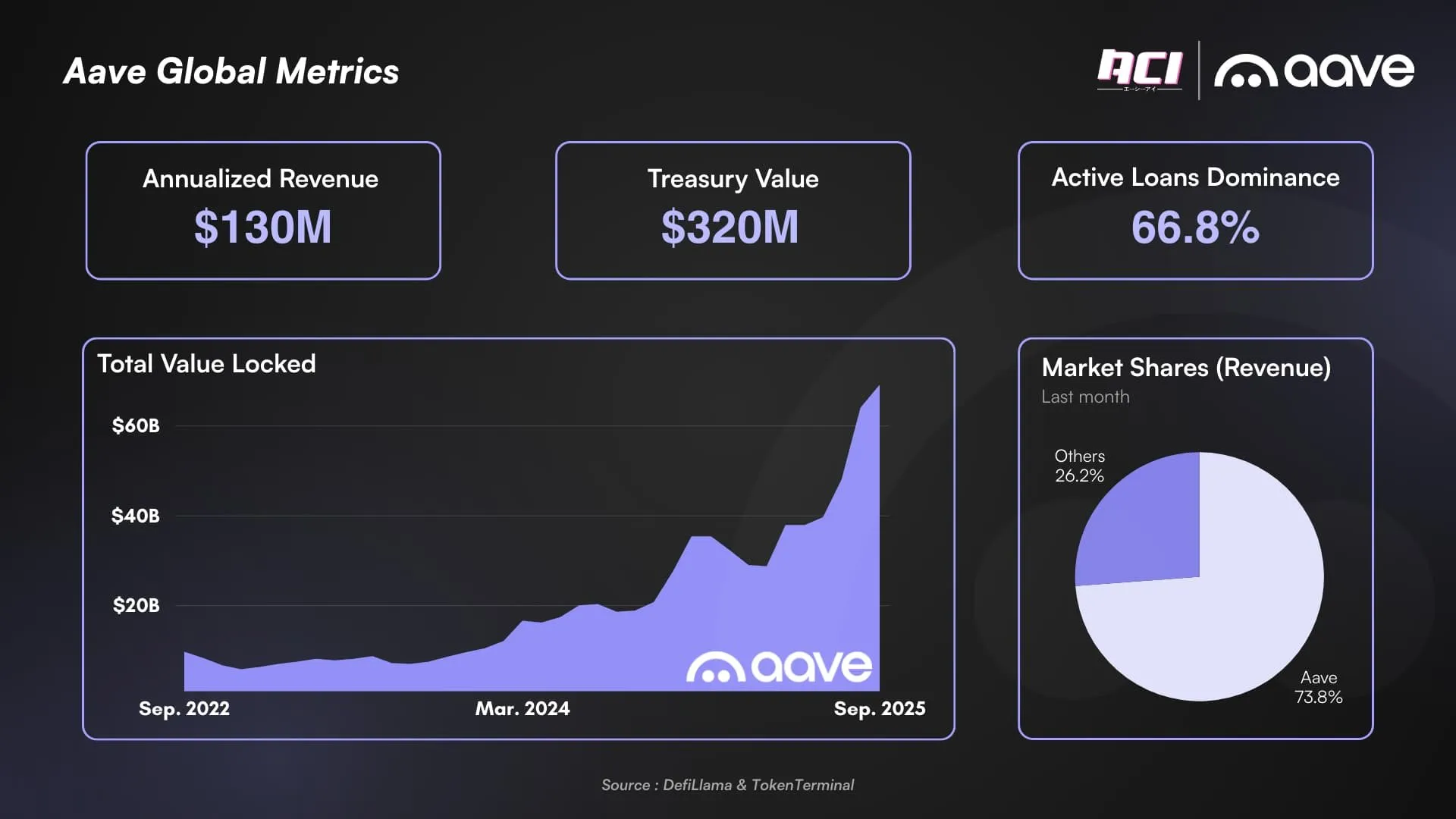
Aave’s $GHO: Backed by Lending Infrastructure
$GHO is the native stablecoin of lending giant Aave. Instead of relying on arbitrage opportunities or exposure to real-world assets, $GHO is fully backed by deposits within Aave’s lending markets. This means that the collateral and liquidity already locked in Aave form the foundation for $GHO’s stability.
Compared to other yield-bearing stablecoins that utilize funding rate arbitrage and RWAs, $GHO’s yield is derived from Aave’s protocol revenue and incentives provided through ecosystem partnerships. This ties it more closely with the health and growth of Aave’s lending platform itself, rather than to external markets.
In a recent governance post by the Initiative founder of Aave DAO, the significance of $GHO for the protocol was highlighted. The post outlined that $GHO is expected to become an increasingly important part of Aave’s roadmap, with potential plans to bundle it into key Centralized and Decentralized Finance (CeDeFi) deals. Such an approach would expand adoption by incorporating $GHO into integrated financial products that span both traditional and decentralized systems.
By anchoring its stablecoin directly within its lending infrastructure and positioning it for broader adoption through partnerships, Aave is reinforcing its central role as one of the most influential protocols in DeFi.
Ethena Labs: Prime Mover of Yield-Bearing Stable Assets
As an early pioneer of yield-bearing stablecoins, Ethena Labs’ $USDe is built on positive funding rate arbitrage as a primary yield source. Over time, it has grown to become the third-largest stablecoin, with a circulating supply of $13.7 billion and a 4.65% share of the overall market, as of September 2025.
Ethena has formed partnerships across both TradFi and DeFi, including with BlackRock, Pendle, and Aave, while also securing integrations with major centralized exchanges such as Binance and Bybit. These connections have helped expand $USDe’s reach and strengthen its position in the stablecoin market.
Most recently, on September 15, 2025, the Ethena Foundation announced the upcoming activation of the $ENA fee switch. Once live, this mechanism could redirect a portion of protocol revenue, $14.2 million in the last week alone, to token holders, adding a new layer of value distribution to the ecosystem.
Resolv Labs: Clusters and Buybacks
Similar to other yield-bearing stablecoins, Resolv Labs’ $USR derives a portion of its yield from staking and funding rate arbitrage. What sets it apart is the introduction of a cluster model, which distributes collateral across a range of DeFi protocols to capture additional yield opportunities. This diversified approach allows Resolv to spread risk while tapping into multiple sources of return.
Launched only in August 2025, Resolv has also rolled out a buyback program that directs 75% of all protocol fees toward weekly open-market purchases of $RESOLV, the governance token. This mechanism is designed to consistently return value to token holders and strengthen the long-term sustainability of the ecosystem.
Sky Ecosystem: Onchain Savings Governance
Sky Ecosystem is powered by its native stablecoin, $USDS, which not only serves as a stable asset but also grants holders access to token rewards and the Sky Savings Rate (SSR). The SSR is a non-custodial savings rail whose variable yield is determined by onchain governance, giving the community direct influence over rate adjustments.
This yield is funded by the protocol’s revenue streams, which include fees from loans, interest earned on real-world assets (RWAs), and deployments across DeFi protocols such as Spark. By combining stablecoin functionality with governance-directed yield, $USDS positions itself as a flexible and community-driven stablecoin designed to adapt over time.
Ondo Finance: Tokenized Treasuries
$USDY is Ondo Finance’s stablecoin, secured by short-term U.S. Treasuries and bank demand deposits. Unlike other yield-bearing stablecoins, it offers holders two distinct ways to receive yield.
Users can opt to hold $USDY, which increases in value over time as yield from underlying assets are accrued. Otherwise, they can opt to hold the rebasing alternative $rUSDY for price stability, which increases token balance over time.
Through LayerZero’s Omnichain Fungible Token (OFT) integration, $USDY employs native multi-chain support, including on Ethereum, Solana, and Sui. Most recently, Ondo also expanded to the Sei Network, further signaling its ambition to become a cross-chain standard for tokenized U.S. Treasuries.
Conclusion
The growth of yield-bearing stablecoins has been massive over the past few years. With greater regulatory clarity emerging and institutional capital actively seeking opportunities onchain, this rapid expansion is expected to continue.
The market leaders will be defined by their ability to scale with demand, deliver sustainable and competitive yields, and unlock greater capital efficiency across a wide range of assets and asset classes.
The DWF Ventures team is excited for the accelerated growth and adoption of yield-bearing stablecoins in the near future. If you are building something interesting in this space, feel free to reach out.
Disclaimer: This article is intended for general informational purposes only and does not constitute financial advice. Readers should conduct their own research and consult with a professional advisor before making any investment decisions.